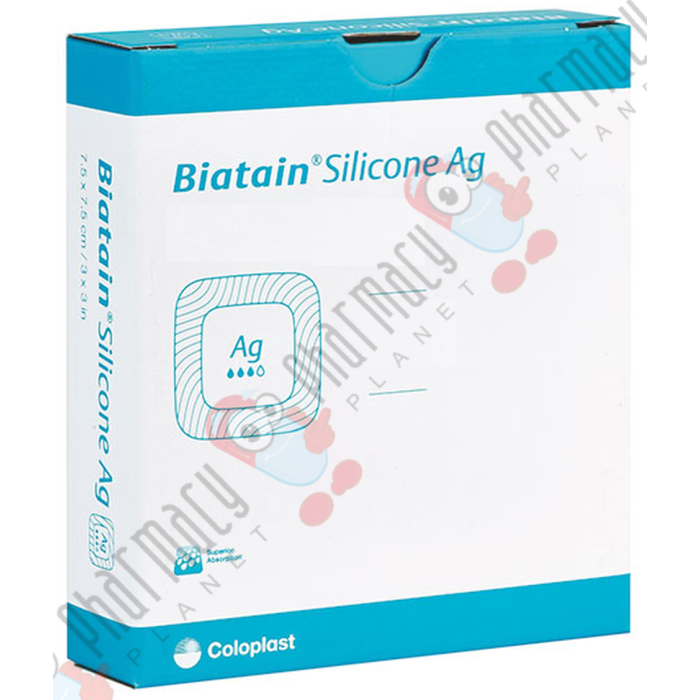
BIATAIN SILICONE AG
Biatain® Silicone Ag is a soft, flexible and absorbent antibacterial foam dressing with a gentle silicone adhesive. Biatain® Silicone Ag contains silver, which is continuously released into the wound. Can be used on infected wounds or wounds at risk of infection.
the items you wish
to order
by our qualified
prescriber
to your door step
Please use the options provided to make your final selection.
Select your preferred options and see the best price
| Pack | Price (£) | ||
|---|---|---|---|
| - | 17.5cm x 17.5cm | 5 | 135.99 |
| - | 15cm x 15cm | 5 | 123.49 |
| - | 12.5cm x 12.5cm | 5 | 74.49 |
| - | 10cm x 10cm | 5 | 43.99 |
| - | 7.5cm x 7.5cm | 5 | 36.49 |
| - | 10cm x 20cm | 5 | 95.49 |
It looks like you missed filling in questions from the last consultation.Click Here to submit your response.
Biatain Silicone Ag | Silver Silicone Foam Dressing for Infected Exuding Wounds
Infected or at-risk wounds in patients with fragile periwound skin present a dual clinical challenge: antimicrobial management is needed at the wound surface while the adhesive border must not cause additional trauma to already damaged skin at removal. Biatain Silicone Ag is a silver-containing foam dressing from Coloplast that addresses both needs. The ionic silver provides local antimicrobial activity, the foam absorbs wound exudate, and the soft silicone adhesive border allows gentle removal on fragile or damaged periwound skin. Available in six sizes from 7.5cm x 7.5cm to 17.5cm x 17.5cm including a rectangular 10cm x 20cm. No prescription is required.
What Is Biatain Silicone Ag?
Biatain Silicone Ag is a regulated Class IIb medical device from Coloplast. It is the silver-containing version of Biatain Silicone Adhesive Dressing, combining three properties in a single self-contained dressing: ionic silver for local antimicrobial activity, a hydrocellular foam core for exudate absorption, and a soft silicone adhesive border for gentle fixation and atraumatic removal.
The "Ag" designation indicates the presence of ionic silver, the same antimicrobial agent found in Biatain Ag Adhesive. The silicone border technology is the same as that in Biatain Silicone Adhesive Dressing — bonding through van der Waals forces rather than chemical adhesive, allowing the border to hold securely during wear, be repositioned during application, and release with less mechanical force at removal than a standard acrylic adhesive border.
The clinical rationale for combining silver with silicone adhesive is patient centred. Chronic infected wounds, particularly venous leg ulcers and pressure ulcers — frequently occur in patients with fragile or damaged periwound skin as a result of long-term wound fluid contact, oedema, skin fragility in older adults, or previous adhesive border trauma. These patients need both antimicrobial wound contact and a border that will not cause further periwound damage at each change.
Biatain Silicone Ag is available in six sizes: 7.5cm x 7.5cm, 10cm x 10cm, 10cm x 20cm, 12.5cm x 12.5cm, 15cm x 15cm, and 17.5cm x 17.5cm, the widest size range in the Biatain Ag silicone format, including the rectangular 10cm x 20cm for elongated wound sites and the 17.5cm x 17.5cm as the largest format.
Silver containing dressings including Biatain Silicone Ag may cause grey or blue grey discolouration of the wound and periwound skin (argyria). Expected, localised, and reversible. Inform patients before treatment begins. Biatain Silicone Ag is not a substitute for systemic antibiotic therapy in spreading cellulitis or systemic infection. Review silver dressing use after two to four weeks and step down to Biatain Silicone Adhesive Dressing when infection is no longer a clinical concern.
How Does Biatain Silicone Ag Work?
Ionic Silver Antimicrobial Activity
Ionic silver is released from the foam as wound exudate contacts the dressing. Silver ions act through multiple mechanisms: disrupting bacterial cell membranes by binding to membrane proteins, interfering with the enzyme systems bacteria need for metabolism and replication, and preventing bacterial DNA replication. This broad-spectrum action covers wound pathogens including Staphylococcus aureus, MRSA, Pseudomonas aeruginosa, and Candida species. The silver acts locally at the wound surface and is not absorbed systemically in clinically significant amounts.
Soft Silicone Adhesive Border
The soft silicone border bonds to the skin through van der Waals forces — intermolecular attraction across the full silicone-to-skin contact area rather than a chemical adhesive bond. This provides reliable adhesion during wear while releasing with less mechanical force at removal, reducing the risk of skin stripping and adhesive border trauma on fragile periwound tissue. The silicone border can also be repositioned during application without losing adhesive function, allowing precise dressing placement over the wound.
Foam Exudate Absorption
The hydrocellular foam core absorbs wound exudate and retains it within the foam structure away from the wound surface. This prevents pooling of exudate at the wound bed, reduces periwound maceration, and maintains a moist wound healing environment at the wound contact surface alongside the local silver activity. The foam provides cushioning over the wound site. The moisture vapour permeable film backing allows evaporation while remaining waterproof to external fluids.
The Combined Clinical Value
The combination of silver antimicrobial activity with a soft silicone adhesive border addresses a specific patient population: those with infected or at risk wounds and fragile periwound skin, where standard acrylic adhesive borders would cause further trauma at each change. Managing both infection and border-related skin trauma simultaneously reduces the overall wound management burden for patients and carers.
How to Apply Biatain Silicone Ag
Before Application
- Wash hands and use appropriate gloves.
- Clean the wound with sterile saline or as directed by a healthcare professional.
- Dry the periwound skin gently. The silicone border adheres to dry intact periwound skin.
- Do not apply oil-based products under or adjacent to the dressing as these impair silver ion release and silicone border adhesion.
Application
- Select the appropriate size: 7.5cm x 7.5cm, 10cm x 10cm, 10cm x 20cm, 12.5cm x 12.5cm, 15cm x 15cm, or 17.5cm x 17.5cm.
- Position the dressing over the wound with the foam pad centred over the wound bed.
- Remove the release liner and press the silicone border onto the surrounding skin.
- If the alignment is not correct, the silicone border can be lifted and repositioned without loss of adhesive function.
- No secondary dressing is required.
- Label with the date and time of application.
Wear Time and Removal
- Biatain Silicone Ag can be worn for up to seven days depending on exudate levels and wound condition.
- Change when exudate approaches the border, the border lifts, or clinical assessment indicates a change is needed.
- To remove, lift one corner of the silicone border and peel slowly. The silicone should release gently.
- Reassess at each change. Review silver dressing use after two to four weeks and step down to Biatain Silicone Adhesive Dressing when infection is resolved.
- Review silver dressing use after two to four weeks. Once infection is no longer a clinical concern, transitioning to Biatain Silicone Adhesive Dressing provides the same soft silicone border and foam format without silver. Prolonged silver dressing use without clinical review is not recommended.
Sizes Available
Biatain Silicone Ag 7.5cm x 7.5cm
The smallest size in the range, suited to small infected or at risk wounds, digit wounds, and localised wound sites where a compact silver silicone-bordered foam is appropriate.
Biatain Silicone Ag 10cm x 10cm
A medium square size for moderate-sized infected or at risk exuding wounds where the combination of silver antimicrobial activity and soft silicone border is clinically indicated and the 10cm x 10cm format provides appropriate wound coverage.
Biatain Silicone Ag 10cm x 20cm
A rectangular format for elongated infected or at risk wound areas on the lower limb and other sites where a rectangular shape provides better coverage than a square. Suitable for venous leg ulcers with infection or significant infection risk, where the elongated format follows the wound course.
Biatain Silicone Ag 12.5cm x 12.5cm
A medium-large square size for moderate to larger infected or at risk wound areas where a 10cm x 10cm format does not provide sufficient coverage and the soft silicone border is the appropriate adhesive choice.
Biatain Silicone Ag 15cm x 15cm
A larger square size for more extensive infected or at risk wounds including larger pressure ulcers and leg ulcer areas where broader silver foam coverage is clinically indicated.
Biatain Silicone Ag 17.5cm x 17.5cm
The largest size in the range, providing the broadest silver silicone foam coverage. Available in Biatain Silicone Ag but not in the non-silver Biatain Silicone Adhesive Dressing range, making this the appropriate format for extensive infected or at risk wound areas where the 15cm x 15cm does not provide adequate coverage.
When selecting a size, ensure the foam pad covers the entire wound bed with the silicone border resting on intact periwound skin on all sides.
Safety Information and Precautions
Contraindications
- Known sensitivity or allergy to silver, silicone, polyurethane foam, or any component of the dressing.
- Do not use on dry or minimally exuding wounds.
- Do not apply oil-based products directly under the dressing.
Precautions
- Single use product. Do not reuse or reapply.
- Silver dressings may cause grey or blue grey discolouration of the wound and periwound skin (argyria). Expected, localised, and reversible. Inform patients before treatment.
- Review silver dressing use after two to four weeks. Step down to Biatain Silicone Adhesive Dressing when infection is no longer a concern.
- Biatain Silicone Ag is not a substitute for systemic antibiotic therapy in spreading cellulitis or systemic infection.
- Assess the periwound skin at every change — even silicone borders can cause irritation on very fragile or broken skin.
- Do not use MRI scanning with the dressing in place.
Adverse Effects
- Grey or blue grey discolouration from silver deposition (argyria). Expected and reversible.
- Local skin irritation at the silicone border. Less common than with acrylic adhesive, but possible.
- Wound desiccation if exudate falls. Reassess dressing choice.
Who Is Biatain Silicone Ag Suitable For?
Biatain Silicone Ag Is Suitable For
- Patients with infected or at risk moderately to heavily exuding wounds and fragile or damaged periwound skin, where both silver antimicrobial management and soft silicone border adhesion are clinically indicated
- Venous leg ulcers, pressure ulcers, and other chronic infected wounds in patients where standard acrylic adhesive borders have caused or risk causing further periwound skin trauma
- Patients on long-term corticosteroids, older adults with skin fragility, and others with periwound skin that has been damaged by previous adhesive trauma
- Adults and children under healthcare professional supervision
Choosing Between Biatain Silicone Ag and Biatain Silicone Adhesive Dressing
Both use a soft silicone adhesive border with van der Waals adhesion and the same foam exudate absorption. Biatain Silicone Ag adds ionic silver for antimicrobial infection management. Biatain Silicone Adhesive Dressing contains no silver and is for clean wounds. Choose Biatain Silicone Ag for infected or at risk wounds where both silver and silicone border properties are needed. Step down to Biatain Silicone Adhesive Dressing once infection resolves and silver is no longer clinically indicated.
Biatain Silicone Ag vs Biatain Ag Adhesive
Both provide silver antimicrobial activity with an integrated adhesive border. Biatain Ag Adhesive (12.5cm x 12.5cm) uses a standard acrylic adhesive border. Biatain Silicone Ag uses a soft silicone border across six sizes. Choose Biatain Silicone Ag when the fragile periwound skin or repositionable application properties of silicone adhesive are clinically important.
Where to Buy and How to Order
Biatain Silicone Ag is a regulated medical device and does not require a prescription. It can be purchased directly through Pharmacy Planet without a clinical consultation. It is available in six sizes: 7.5cm x 7.5cm, 10cm x 10cm, 10cm x 20cm, 12.5cm x 12.5cm, 15cm x 15cm, and 17.5cm x 17.5cm.
Pharmacy Planet stocks Biatain Silicone Ag alongside Biatain Silicone Adhesive Dressing, Biatain Ag Adhesive, and the full Biatain range. Our pharmacists can advise on the most appropriate silver or non-silver silicone bordered foam for a specific wound.
For complex infected wounds or wounds not healing as expected, seek clinical assessment from a tissue viability nurse, district nurse, or GP alongside your dressing purchase.
Storage and Handling
- Store in a cool, dry place away from direct sunlight and moisture.
- Store below 25°C.
- Keep in the original sealed packaging until immediately before use.
- Each dressing is individually sterile packed. Do not use if the packaging is damaged or compromised.
- Check the expiry date before use. Do not use after the expiry date.
- Once opened, apply immediately.
- Keep out of the reach of children.
- Dispose of used dressings as clinical waste in accordance with local guidelines.
Why Choose Pharmacy Planet?
Pharmacy Planet is a GPhC registered online pharmacy providing access to all six sizes of Biatain Silicone Ag alongside the full Biatain range. All products are genuine and sourced through regulated supply chains.
Our pharmacists are available to advise on silver dressing selection, the choice between silicone and acrylic adhesive formats, and on when clinical referral for wound assessment is appropriate.
References
- Coloplast. Biatain Silicone Ag — Instructions for Use. Coloplast Ltd. https://www.coloplast.co.uk. Accessed May 2026.
- World Union of Wound Healing Societies (WUWHS). Antimicrobials and non-healing wounds: evidence, controversies and suggestions. https://wuwhs.net. Accessed May 2026.
- Wounds UK. Best Practice Statement: Wound exudate — effective assessment and management. https://www.wounds-uk.com. Accessed May 2026.
- National Institute for Health and Care Excellence (NICE). Wound care products — Drug Tariff prescribing and selection. https://www.nice.org.uk. Accessed May 2026.
Infected or at-risk wounds in patients with fragile periwound skin present a dual clinical challenge: antimicrobial management is needed at the wound surface while the adhesive border must not cause additional trauma to already damaged skin at removal. Biatain Silicone Ag is a silver-containing foam dressing from Coloplast that addresses both needs. The ionic silver provides local antimicrobial activity, the foam absorbs wound exudate, and the soft silicone adhesive border allows gentle removal on fragile or damaged periwound skin. Available in six sizes from 7.5cm x 7.5cm to 17.5cm x 17.5cm including a rectangular 10cm x 20cm. No prescription is required.
Biatain Silicone Ag is a regulated Class IIb medical device from Coloplast. It is the silver-containing version of Biatain Silicone Adhesive Dressing, combining three properties in a single self-contained dressing: ionic silver for local antimicrobial activity, a hydrocellular foam core for exudate absorption, and a soft silicone adhesive border for gentle fixation and atraumatic removal.
The "Ag" designation indicates the presence of ionic silver, the same antimicrobial agent found in Biatain Ag Adhesive. The silicone border technology is the same as that in Biatain Silicone Adhesive Dressing — bonding through van der Waals forces rather than chemical adhesive, allowing the border to hold securely during wear, be repositioned during application, and release with less mechanical force at removal than a standard acrylic adhesive border.
The clinical rationale for combining silver with silicone adhesive is patient centred. Chronic infected wounds, particularly venous leg ulcers and pressure ulcers — frequently occur in patients with fragile or damaged periwound skin as a result of long-term wound fluid contact, oedema, skin fragility in older adults, or previous adhesive border trauma. These patients need both antimicrobial wound contact and a border that will not cause further periwound damage at each change.
Biatain Silicone Ag is available in six sizes: 7.5cm x 7.5cm, 10cm x 10cm, 10cm x 20cm, 12.5cm x 12.5cm, 15cm x 15cm, and 17.5cm x 17.5cm, the widest size range in the Biatain Ag silicone format, including the rectangular 10cm x 20cm for elongated wound sites and the 17.5cm x 17.5cm as the largest format.
Silver containing dressings including Biatain Silicone Ag may cause grey or blue grey discolouration of the wound and periwound skin (argyria). Expected, localised, and reversible. Inform patients before treatment begins. Biatain Silicone Ag is not a substitute for systemic antibiotic therapy in spreading cellulitis or systemic infection. Review silver dressing use after two to four weeks and step down to Biatain Silicone Adhesive Dressing when infection is no longer a clinical concern.
Ionic Silver Antimicrobial Activity
Ionic silver is released from the foam as wound exudate contacts the dressing. Silver ions act through multiple mechanisms: disrupting bacterial cell membranes by binding to membrane proteins, interfering with the enzyme systems bacteria need for metabolism and replication, and preventing bacterial DNA replication. This broad-spectrum action covers wound pathogens including Staphylococcus aureus, MRSA, Pseudomonas aeruginosa, and Candida species. The silver acts locally at the wound surface and is not absorbed systemically in clinically significant amounts.
Soft Silicone Adhesive Border
The soft silicone border bonds to the skin through van der Waals forces — intermolecular attraction across the full silicone-to-skin contact area rather than a chemical adhesive bond. This provides reliable adhesion during wear while releasing with less mechanical force at removal, reducing the risk of skin stripping and adhesive border trauma on fragile periwound tissue. The silicone border can also be repositioned during application without losing adhesive function, allowing precise dressing placement over the wound.
Foam Exudate Absorption
The hydrocellular foam core absorbs wound exudate and retains it within the foam structure away from the wound surface. This prevents pooling of exudate at the wound bed, reduces periwound maceration, and maintains a moist wound healing environment at the wound contact surface alongside the local silver activity. The foam provides cushioning over the wound site. The moisture vapour permeable film backing allows evaporation while remaining waterproof to external fluids.
The Combined Clinical Value
The combination of silver antimicrobial activity with a soft silicone adhesive border addresses a specific patient population: those with infected or at risk wounds and fragile periwound skin, where standard acrylic adhesive borders would cause further trauma at each change. Managing both infection and border-related skin trauma simultaneously reduces the overall wound management burden for patients and carers.
Before Application
- Wash hands and use appropriate gloves.
- Clean the wound with sterile saline or as directed by a healthcare professional.
- Dry the periwound skin gently. The silicone border adheres to dry intact periwound skin.
- Do not apply oil-based products under or adjacent to the dressing as these impair silver ion release and silicone border adhesion.
Application
- Select the appropriate size: 7.5cm x 7.5cm, 10cm x 10cm, 10cm x 20cm, 12.5cm x 12.5cm, 15cm x 15cm, or 17.5cm x 17.5cm.
- Position the dressing over the wound with the foam pad centred over the wound bed.
- Remove the release liner and press the silicone border onto the surrounding skin.
- If the alignment is not correct, the silicone border can be lifted and repositioned without loss of adhesive function.
- No secondary dressing is required.
- Label with the date and time of application.
Wear Time and Removal
- Biatain Silicone Ag can be worn for up to seven days depending on exudate levels and wound condition.
- Change when exudate approaches the border, the border lifts, or clinical assessment indicates a change is needed.
- To remove, lift one corner of the silicone border and peel slowly. The silicone should release gently.
- Reassess at each change. Review silver dressing use after two to four weeks and step down to Biatain Silicone Adhesive Dressing when infection is resolved.
- Review silver dressing use after two to four weeks. Once infection is no longer a clinical concern, transitioning to Biatain Silicone Adhesive Dressing provides the same soft silicone border and foam format without silver. Prolonged silver dressing use without clinical review is not recommended.
Biatain Silicone Ag 7.5cm x 7.5cm
The smallest size in the range, suited to small infected or at risk wounds, digit wounds, and localised wound sites where a compact silver silicone-bordered foam is appropriate.
Biatain Silicone Ag 10cm x 10cm
A medium square size for moderate-sized infected or at risk exuding wounds where the combination of silver antimicrobial activity and soft silicone border is clinically indicated and the 10cm x 10cm format provides appropriate wound coverage.
Biatain Silicone Ag 10cm x 20cm
A rectangular format for elongated infected or at risk wound areas on the lower limb and other sites where a rectangular shape provides better coverage than a square. Suitable for venous leg ulcers with infection or significant infection risk, where the elongated format follows the wound course.
Biatain Silicone Ag 12.5cm x 12.5cm
A medium-large square size for moderate to larger infected or at risk wound areas where a 10cm x 10cm format does not provide sufficient coverage and the soft silicone border is the appropriate adhesive choice.
Biatain Silicone Ag 15cm x 15cm
A larger square size for more extensive infected or at risk wounds including larger pressure ulcers and leg ulcer areas where broader silver foam coverage is clinically indicated.
Biatain Silicone Ag 17.5cm x 17.5cm
The largest size in the range, providing the broadest silver silicone foam coverage. Available in Biatain Silicone Ag but not in the non-silver Biatain Silicone Adhesive Dressing range, making this the appropriate format for extensive infected or at risk wound areas where the 15cm x 15cm does not provide adequate coverage.
When selecting a size, ensure the foam pad covers the entire wound bed with the silicone border resting on intact periwound skin on all sides.
Contraindications
- Known sensitivity or allergy to silver, silicone, polyurethane foam, or any component of the dressing.
- Do not use on dry or minimally exuding wounds.
- Do not apply oil-based products directly under the dressing.
Precautions
- Single use product. Do not reuse or reapply.
- Silver dressings may cause grey or blue grey discolouration of the wound and periwound skin (argyria). Expected, localised, and reversible. Inform patients before treatment.
- Review silver dressing use after two to four weeks. Step down to Biatain Silicone Adhesive Dressing when infection is no longer a concern.
- Biatain Silicone Ag is not a substitute for systemic antibiotic therapy in spreading cellulitis or systemic infection.
- Assess the periwound skin at every change — even silicone borders can cause irritation on very fragile or broken skin.
- Do not use MRI scanning with the dressing in place.
Adverse Effects
- Grey or blue grey discolouration from silver deposition (argyria). Expected and reversible.
- Local skin irritation at the silicone border. Less common than with acrylic adhesive, but possible.
- Wound desiccation if exudate falls. Reassess dressing choice.
Biatain Silicone Ag Is Suitable For
- Patients with infected or at risk moderately to heavily exuding wounds and fragile or damaged periwound skin, where both silver antimicrobial management and soft silicone border adhesion are clinically indicated
- Venous leg ulcers, pressure ulcers, and other chronic infected wounds in patients where standard acrylic adhesive borders have caused or risk causing further periwound skin trauma
- Patients on long-term corticosteroids, older adults with skin fragility, and others with periwound skin that has been damaged by previous adhesive trauma
- Adults and children under healthcare professional supervision
Both use a soft silicone adhesive border with van der Waals adhesion and the same foam exudate absorption. Biatain Silicone Ag adds ionic silver for antimicrobial infection management. Biatain Silicone Adhesive Dressing contains no silver and is for clean wounds. Choose Biatain Silicone Ag for infected or at risk wounds where both silver and silicone border properties are needed. Step down to Biatain Silicone Adhesive Dressing once infection resolves and silver is no longer clinically indicated.
Both provide silver antimicrobial activity with an integrated adhesive border. Biatain Ag Adhesive (12.5cm x 12.5cm) uses a standard acrylic adhesive border. Biatain Silicone Ag uses a soft silicone border across six sizes. Choose Biatain Silicone Ag when the fragile periwound skin or repositionable application properties of silicone adhesive are clinically important.
Biatain Silicone Ag is a regulated medical device and does not require a prescription. It can be purchased directly through Pharmacy Planet without a clinical consultation. It is available in six sizes: 7.5cm x 7.5cm, 10cm x 10cm, 10cm x 20cm, 12.5cm x 12.5cm, 15cm x 15cm, and 17.5cm x 17.5cm.
Pharmacy Planet stocks Biatain Silicone Ag alongside Biatain Silicone Adhesive Dressing, Biatain Ag Adhesive, and the full Biatain range. Our pharmacists can advise on the most appropriate silver or non-silver silicone bordered foam for a specific wound.
For complex infected wounds or wounds not healing as expected, seek clinical assessment from a tissue viability nurse, district nurse, or GP alongside your dressing purchase.
- Store in a cool, dry place away from direct sunlight and moisture.
- Store below 25°C.
- Keep in the original sealed packaging until immediately before use.
- Each dressing is individually sterile packed. Do not use if the packaging is damaged or compromised.
- Check the expiry date before use. Do not use after the expiry date.
- Once opened, apply immediately.
- Keep out of the reach of children.
- Dispose of used dressings as clinical waste in accordance with local guidelines.
Pharmacy Planet is a GPhC registered online pharmacy providing access to all six sizes of Biatain Silicone Ag alongside the full Biatain range. All products are genuine and sourced through regulated supply chains.
Our pharmacists are available to advise on silver dressing selection, the choice between silicone and acrylic adhesive formats, and on when clinical referral for wound assessment is appropriate.
References
- Coloplast. Biatain Silicone Ag — Instructions for Use. Coloplast Ltd. https://www.coloplast.co.uk. Accessed May 2026.
- World Union of Wound Healing Societies (WUWHS). Antimicrobials and non-healing wounds: evidence, controversies and suggestions. https://wuwhs.net. Accessed May 2026.
- Wounds UK. Best Practice Statement: Wound exudate — effective assessment and management. https://www.wounds-uk.com. Accessed May 2026.
- National Institute for Health and Care Excellence (NICE). Wound care products — Drug Tariff prescribing and selection. https://www.nice.org.uk. Accessed May 2026.
Biatain Silicone Ag is a silver-containing foam dressing from Coloplast with a soft silicone adhesive border for infected or at risk moderately to heavily exuding wounds, particularly in patients with fragile or damaged periwound skin. The ionic silver provides local antimicrobial activity. The soft silicone border releases gently at removal. The foam absorbs wound exudate. Six sizes from 7.5cm x 7.5cm to 17.5cm x 17.5cm. No prescription required.
Both have a soft silicone adhesive border and foam exudate absorption. Biatain Silicone Ag adds ionic silver for antimicrobial infection management and is available in six sizes including the 17.5cm x 17.5cm. Biatain Silicone Adhesive Dressing contains no silver and is for clean wounds. Choose Biatain Silicone Ag when infection or significant infection risk is present. Step down to Biatain Silicone Adhesive Dressing once the infection has resolved.
Soft silicone adhesive bonds to skin through van der Waals forces rather than chemical adhesive, releasing with less mechanical force at removal and causing less skin stripping on fragile periwound tissue. This is clinically relevant for infected wound patients who often have damaged or fragile periwound skin from chronic wound fluid contact, oedema, or previous adhesive trauma. The silicone border can also be repositioned during application without losing adhesive function.
Both provide ionic silver antimicrobial activity with an integrated adhesive border. Biatain Ag Adhesive (12.5cm x 12.5cm) uses a standard acrylic adhesive border. Biatain Silicone Ag uses a soft silicone adhesive border across six sizes including 7.5cm x 7.5cm and 17.5cm x 17.5cm. Choose Biatain Silicone Ag when fragile periwound skin makes a gentler silicone border clinically preferable or when a different size is needed.
Silver containing dressings including Biatain Silicone Ag can cause grey or blue grey discolouration of the wound bed and surrounding periwound skin, known as argyria. This is caused by silver deposition in the tissue, is localised to the wound area, and is generally reversible after silver dressing use is discontinued. It is cosmetically significant rather than clinically harmful. Patients should be informed before treatment begins.
Silver dressings are typically reviewed after two to four weeks of use. Once the wound shows signs of infection resolution and is progressing toward healing, transitioning to Biatain Silicone Adhesive Dressing provides the same soft silicone border and foam format without silver. Prolonged silver dressing use without clinical review is not recommended. Seek guidance from a tissue viability nurse or district nurse on appropriate silver dressing duration.
No. Biatain Silicone Ag provides local silver antimicrobial activity at the wound surface and is not appropriate as sole treatment for spreading cellulitis, systemic infection, or sepsis. These require systemic antibiotic therapy and urgent clinical assessment. If spreading redness beyond the wound margin, fever, or other systemic infection signs are present, seek urgent clinical assessment. Biatain Silicone Ag can be used alongside systemic treatment but does not replace it.
No. Biatain Silicone Ag is a regulated medical device and does not require a prescription. It can be purchased directly from Pharmacy Planet without a clinical consultation in six sizes: 7.5cm x 7.5cm, 10cm x 10cm, 10cm x 20cm, 12.5cm x 12.5cm, 15cm x 15cm, and 17.5cm x 17.5cm. For complex or infected wounds not healing as expected, seek clinical assessment from a tissue viability nurse, district nurse, or GP.

clinical consultation
Answer a few questions on your health and your fitness goals.

assessment
Our clinicians will review your clinical questionnaire to make sure treatment is right for you.

aboard!
Once approved, you will access our wealth of experience and resources curated by our team and begin your clinical journey.
Start your journey with us
Need Help?

Start your weight loss journey heading in the right direction. Our team are here to help. Whether you’re unsure about which medicine is right for you or need help navigating the world of weight loss drugs, our team are on hand to help you make the right decision. We can put you in touch with one of our experienced weight loss clinicians so you can be sure you’re making the best decision with the most accurate information.
To get in touch, contact our Customer Service team on 0800 978 8956 or email headoffice@pharmacyplanet.com.

Review By
GURDEV SEHMI
Last Updated On : Mar 13 2026
BSc Pharm, MRPharmS, Independent Prescriber, Superintendent Pharmacist, Clinical Lead
GPhC Number: 2050925

Authored By
GURDEV SEHMI
Last Reviewed On : Mar 23 2026
BSc Pharm, MRPharmS, Independent Prescriber, Superintendent Pharmacist, Clinical Lead
GPhC Number: 2050925