







LEUKOSTRIP
Leukostrip wound closure strips are made of 100% polyamide material coated with a hypoallergenic adhesive which allows almost pain free closure of the wound.
the items you wish
to order
by our qualified
prescriber
to your door step
Please use the options provided to make your final selection.
Select your preferred options and see the best price
| Pack | Price (£) | ||
|---|---|---|---|
| - | 6.4mm x 76mm [30] | 1 box | 18.49 |
| - | 6.4mm x 76mm (3 STRIPS) [50] | 1 box | 73.99 |
It looks like you missed filling in questions from the last consultation.Click Here to submit your response.
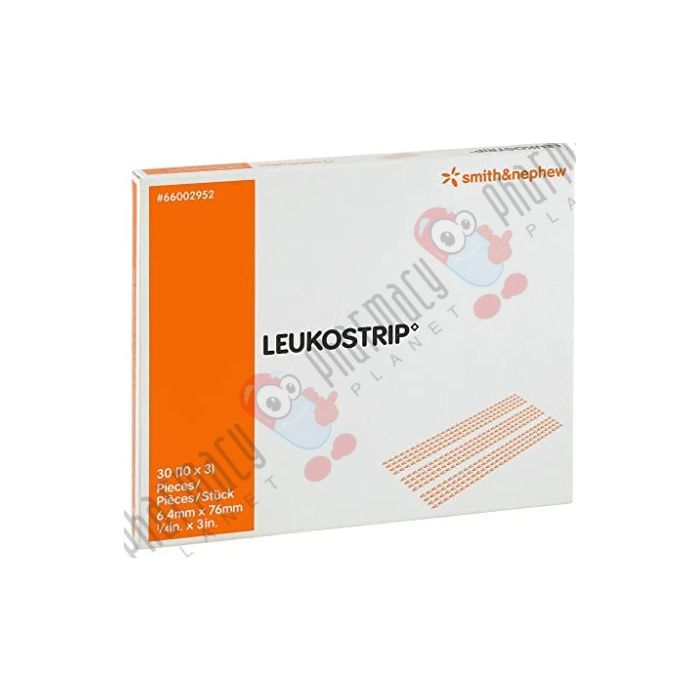
Leukostrip | Adhesive Skin Closure Strips for Wound Edge Support
Small cuts and lacerations that do not require sutures, and wounds where additional support is needed after stitches are removed, benefit from a wound closure method that works at the skin surface without penetrating the tissue. Adhesive skin closure strips hold the wound edges together by adhering to the skin on both sides of the wound, providing support while healing completes at the surface and beneath. Leukostrip is an adhesive skin closure strip from Smith & Nephew. Two configurations: a pack of 30 individual strips and a pack of 50 three-strip cards. Each strip measures 6.4mm x 76mm. No prescription required.
What Is Leukostrip?
Leukostrip is a regulated medical device from Smith & Nephew. It is an adhesive skin closure strip consisting of a porous carrier material coated with a medical grade adhesive. The strip spans the wound gap, adhering to the dry intact skin on each side of the wound, and holds the wound edges in approximation while healing proceeds. The strips are applied directly by the user and fall away naturally as the wound heals or can be removed gently when the wound has healed.
Skin closure strips sit within the broader category of wound closure methods alongside sutures, staples, clips, and tissue adhesives. Their clinical position is as a surface-only closure method requiring no skin penetration. They are appropriate for minor lacerations, small incisions, wound support after suture or clip removal, and wound protection in the later healing stages, where additional surface support reduces wound dehiscence risk.
The carrier material of Leukostrip is porous. The porous structure allows some moisture vapour to pass through the strip from the skin surface beneath. This reduces the accumulation of moisture under the strip that can occur with fully occlusive dressings and supports comfortable wear over the healing period. The medical grade adhesive is designed to adhere to intact skin without requiring moisture or solvent activation.
Leukostrip is available in two configurations, both using the same 6.4mm x 76mm strip: a pack of 30 individual strips, and a pack of 50 three-strip cards where three strips are presented together on a backing card.
Leukostrip is for use on dry, intact skin surrounding minor wounds only. Do not apply to wet, greasy, or damaged periwound skin as the adhesive will not bond effectively. Do not use on infected wounds. Do not apply across joints without clinical guidance, as movement can cause the strips to peel. Leukostrip holds wound edges at the skin surface only and is not suitable for deep wounds or wounds under significant tension. For wound types beyond minor lacerations and incision support, seek clinical assessment.
How Leukostrip Works
Adhesive Surface Closure
The medical grade adhesive on the underside of the Leukostrip carrier bonds to the dry intact skin surface on both sides of the wound when the strip is pressed onto the skin. The strip spans the wound gap, and the adhesive holds both sides of the wound in approximation. The tension in the strip and the adhesive bond keep the wound edges in contact while the healing process closes the wound from beneath. The strip does not penetrate the skin or interact with the wound tissue directly.
Porous Carrier Structure
The carrier material is porous, meaning it is permeated with small openings that allow moisture vapour from the skin surface to evaporate through the strip rather than accumulating beneath it. Moisture accumulating under an occlusive covering can macerate the skin and weaken the adhesive bond. The porous structure maintains a more comfortable wearing environment and supports better adhesion over the period needed for healing.
Surface Healing Support
Wound closure strips support the surface of a healing wound in a similar way to the final tape used after suture removal. As the wound heals beneath the surface, the dermal and subcutaneous layers form new tissue to close the wound depth. The skin closure strip supports the surface wound edges during this period, reduces the mechanical tension on the surface from movement and clothing contact, and protects the healing surface from minor trauma and contamination.
Natural Separation or Removal
Leukostrip strips naturally loosen and separate from the skin as the wound heals and skin cell turnover progresses beneath the adhesive. They can also be removed gently by lifting one end and peeling slowly back along the skin surface. Do not pull the strip upward away from the skin at a sharp angle as this can cause skin stripping, particularly in patients with fragile skin. Soak with water or saline to soften the adhesive if the strip feels firmly bonded before removal is attempted.
How to Apply Leukostrip
Before Application
- Clean the wound with sterile saline or as directed. Pat dry thoroughly.
- Ensure the periwound skin is completely dry. The adhesive requires dry skin to bond.
- Do not apply creams, lotions, or antiseptic agents to the skin surface where the strips will adhere.
Applying the Strips
- Hold the wound edges together or have an assistant hold them in approximation.
- Peel the strip from its backing card and position it centrally across the wound gap.
- Press one end firmly onto the skin on one side of the wound.
- Holding the wound edges in approximation, press the other end firmly onto the skin on the opposite side.
- Smooth the strip down from the centre outward on each side.
- Apply additional strips at regular intervals along the wound length, spacing them evenly to distribute the closure support.
After Application
- Apply a light protective dressing over the strips if clinically indicated.
- Keep the strips dry for at least the first 24 to 48 hours.
- Do not scratch or pick at the strips. Allow them to separate naturally or seek clinical guidance on removal.
- If a strip peels before the wound has healed, replace it with a fresh strip if the skin is still clean and dry.
Do not attempt to hold together wound edges that keep separating despite strip application. Wounds that cannot be held closed with strips alone may require sutures or clinical assessment for another closure method. Seek medical advice for any wound that appears deep, that bleeds significantly, or that does not close when the edges are held together gently.
Available Configurations
Leukostrip 6.4mm x 76mm: Pack of 30 Individual Strips
Thirty individual strips, each measuring 6.4mm wide by 76mm long. Each strip is handled individually, giving precise placement control when applying strips to a wound. Suited to minor wound closure at home, in a first aid kit, or in a clinical setting where individual strip handling is preferred.
Leukostrip 6.4mm x 76mm (3 Strips per Card): Pack of 50 Cards
Fifty cards each carrying three 6.4mm x 76mm strips, giving 150 strips in total. The three-strip card format is suited to clinical settings where multiple wound closures are performed regularly, and the efficiency of three strips presented together on one card speeds application. Also suited to facilities stocking wound closure materials in higher volumes for ongoing use.
Both configurations use identical strips. Selection between them is based on the volume of strips needed and whether individual handling or a three-strip card presentation better suits the clinical or home setting.
Safety Information and Precautions
When Not to Use Leukostrip
- Wet, greasy, or otherwise compromised periwound skin where adhesive will not bond adequately.
- Infected or contaminated wounds.
- Deep wounds or wounds under significant tension where surface strips alone cannot maintain closure.
- Wounds around joints without clinical guidance on management of wound movement.
- Known sensitivity to the adhesive components.
Precautions
- Apply to dry skin only.
- Do not apply creams or antiseptic to the application area.
- Soak in water or saline before removal if strips feel firmly bonded to fragile skin.
- Do not peel strips upward at a sharp angle from fragile or elderly skin.
Adverse Effects
- Skin stripping or tearing if strips are removed forcefully from fragile or sensitive skin.
- Adhesive skin reaction in individuals with sensitivity to the adhesive formulation.
- Wound edge separation if the wound is under more tension than the strips can manage.
Suitability
Suitable Uses for Leukostrip
- Closure of small, clean, superficial lacerations on low-tension skin sites
- Supplementary wound support after suture, clip, or staple removal, to maintain wound edge approximation during final healing
- Wound protection in the later stages of healing when the wound is closed but surface support is still beneficial
- Minor incision support in post-operative settings where the clinical team confirms strip closure is appropriate
- First aid wound care for minor cuts where adhesive strip closure is clinically adequate
- Adults and children, with careful application on fragile or elderly skin
Skin Closure Strips vs Other Wound Closure Methods
Skin closure strips provide surface adhesive closure without tissue penetration. They are appropriate for minor wounds where the wound edges are not under significant tension, and the periwound skin is intact and dry. Sutures provide stronger closure through tissue and are appropriate for deeper wounds, wounds under tension, and wounds in anatomically challenging locations. Skin clips and staples provide surface metallic closure applied by a clinician. Tissue adhesives provide a liquid bond across the wound surface. The clinical team selects the appropriate method based on wound assessment.
Purchasing Leukostrip
Leukostrip does not require a prescription. Both configurations are available from Pharmacy Planet without a clinical consultation.
Our pharmacists can advise on which configuration suits the intended use and on appropriate wound management practice alongside skin closure strips.
For wounds that are deep, heavily bleeding, on the face, over a joint, or show signs of infection, seek clinical assessment rather than managing with adhesive strips alone.
Storage
- Store in a cool, dry place away from direct heat and sunlight.
- Do not store above 25 degrees C.
- Keep in original sealed packaging until immediately before use.
- Do not use if the packaging seal is broken.
- Check expiry date before use.
- Keep out of reach of children.
Why Choose Pharmacy Planet?
Pharmacy Planet is a GPhC registered online pharmacy. Both Leukostrip configurations are genuine Smith & Nephew products stocked through regulated UK supply chains.
Our pharmacists can advise on skin closure strip use and on wound management practice for minor wounds.
References
- Smith & Nephew. Leukostrip — Product Information. Smith & Nephew. https://www.smith-nephew.com. Accessed June 2026.
- NHS. How to treat minor cuts and grazes at home. https://www.nhs.uk/conditions/cuts-and-grazes. Accessed June 2026.
- National Institute for Health and Care Excellence. Wound closure: selection of method and materials. https://www.nice.org.uk. Accessed June 2026.
Small cuts and lacerations that do not require sutures, and wounds where additional support is needed after stitches are removed, benefit from a wound closure method that works at the skin surface without penetrating the tissue. Adhesive skin closure strips hold the wound edges together by adhering to the skin on both sides of the wound, providing support while healing completes at the surface and beneath. Leukostrip is an adhesive skin closure strip from Smith & Nephew. Two configurations: a pack of 30 individual strips and a pack of 50 three-strip cards. Each strip measures 6.4mm x 76mm. No prescription required.
Leukostrip is a regulated medical device from Smith & Nephew. It is an adhesive skin closure strip consisting of a porous carrier material coated with a medical grade adhesive. The strip spans the wound gap, adhering to the dry intact skin on each side of the wound, and holds the wound edges in approximation while healing proceeds. The strips are applied directly by the user and fall away naturally as the wound heals or can be removed gently when the wound has healed.
Skin closure strips sit within the broader category of wound closure methods alongside sutures, staples, clips, and tissue adhesives. Their clinical position is as a surface-only closure method requiring no skin penetration. They are appropriate for minor lacerations, small incisions, wound support after suture or clip removal, and wound protection in the later healing stages, where additional surface support reduces wound dehiscence risk.
The carrier material of Leukostrip is porous. The porous structure allows some moisture vapour to pass through the strip from the skin surface beneath. This reduces the accumulation of moisture under the strip that can occur with fully occlusive dressings and supports comfortable wear over the healing period. The medical grade adhesive is designed to adhere to intact skin without requiring moisture or solvent activation.
Leukostrip is available in two configurations, both using the same 6.4mm x 76mm strip: a pack of 30 individual strips, and a pack of 50 three-strip cards where three strips are presented together on a backing card.
Leukostrip is for use on dry, intact skin surrounding minor wounds only. Do not apply to wet, greasy, or damaged periwound skin as the adhesive will not bond effectively. Do not use on infected wounds. Do not apply across joints without clinical guidance, as movement can cause the strips to peel. Leukostrip holds wound edges at the skin surface only and is not suitable for deep wounds or wounds under significant tension. For wound types beyond minor lacerations and incision support, seek clinical assessment.
Adhesive Surface Closure
The medical grade adhesive on the underside of the Leukostrip carrier bonds to the dry intact skin surface on both sides of the wound when the strip is pressed onto the skin. The strip spans the wound gap, and the adhesive holds both sides of the wound in approximation. The tension in the strip and the adhesive bond keep the wound edges in contact while the healing process closes the wound from beneath. The strip does not penetrate the skin or interact with the wound tissue directly.
Porous Carrier Structure
The carrier material is porous, meaning it is permeated with small openings that allow moisture vapour from the skin surface to evaporate through the strip rather than accumulating beneath it. Moisture accumulating under an occlusive covering can macerate the skin and weaken the adhesive bond. The porous structure maintains a more comfortable wearing environment and supports better adhesion over the period needed for healing.
Surface Healing Support
Wound closure strips support the surface of a healing wound in a similar way to the final tape used after suture removal. As the wound heals beneath the surface, the dermal and subcutaneous layers form new tissue to close the wound depth. The skin closure strip supports the surface wound edges during this period, reduces the mechanical tension on the surface from movement and clothing contact, and protects the healing surface from minor trauma and contamination.
Natural Separation or Removal
Leukostrip strips naturally loosen and separate from the skin as the wound heals and skin cell turnover progresses beneath the adhesive. They can also be removed gently by lifting one end and peeling slowly back along the skin surface. Do not pull the strip upward away from the skin at a sharp angle as this can cause skin stripping, particularly in patients with fragile skin. Soak with water or saline to soften the adhesive if the strip feels firmly bonded before removal is attempted.
Before Application
- Clean the wound with sterile saline or as directed. Pat dry thoroughly.
- Ensure the periwound skin is completely dry. The adhesive requires dry skin to bond.
- Do not apply creams, lotions, or antiseptic agents to the skin surface where the strips will adhere.
Applying the Strips
- Hold the wound edges together or have an assistant hold them in approximation.
- Peel the strip from its backing card and position it centrally across the wound gap.
- Press one end firmly onto the skin on one side of the wound.
- Holding the wound edges in approximation, press the other end firmly onto the skin on the opposite side.
- Smooth the strip down from the centre outward on each side.
- Apply additional strips at regular intervals along the wound length, spacing them evenly to distribute the closure support.
After Application
- Apply a light protective dressing over the strips if clinically indicated.
- Keep the strips dry for at least the first 24 to 48 hours.
- Do not scratch or pick at the strips. Allow them to separate naturally or seek clinical guidance on removal.
- If a strip peels before the wound has healed, replace it with a fresh strip if the skin is still clean and dry.
Do not attempt to hold together wound edges that keep separating despite strip application. Wounds that cannot be held closed with strips alone may require sutures or clinical assessment for another closure method. Seek medical advice for any wound that appears deep, that bleeds significantly, or that does not close when the edges are held together gently.
Leukostrip 6.4mm x 76mm: Pack of 30 Individual Strips
Thirty individual strips, each measuring 6.4mm wide by 76mm long. Each strip is handled individually, giving precise placement control when applying strips to a wound. Suited to minor wound closure at home, in a first aid kit, or in a clinical setting where individual strip handling is preferred.
Leukostrip 6.4mm x 76mm (3 Strips per Card): Pack of 50 Cards
Fifty cards each carrying three 6.4mm x 76mm strips, giving 150 strips in total. The three-strip card format is suited to clinical settings where multiple wound closures are performed regularly, and the efficiency of three strips presented together on one card speeds application. Also suited to facilities stocking wound closure materials in higher volumes for ongoing use.
Both configurations use identical strips. Selection between them is based on the volume of strips needed and whether individual handling or a three-strip card presentation better suits the clinical or home setting.
When Not to Use Leukostrip
- Wet, greasy, or otherwise compromised periwound skin where adhesive will not bond adequately.
- Infected or contaminated wounds.
- Deep wounds or wounds under significant tension where surface strips alone cannot maintain closure.
- Wounds around joints without clinical guidance on management of wound movement.
- Known sensitivity to the adhesive components.
Precautions
- Apply to dry skin only.
- Do not apply creams or antiseptic to the application area.
- Soak in water or saline before removal if strips feel firmly bonded to fragile skin.
- Do not peel strips upward at a sharp angle from fragile or elderly skin.
Adverse Effects
- Skin stripping or tearing if strips are removed forcefully from fragile or sensitive skin.
- Adhesive skin reaction in individuals with sensitivity to the adhesive formulation.
- Wound edge separation if the wound is under more tension than the strips can manage.
Suitable Uses for Leukostrip
- Closure of small, clean, superficial lacerations on low-tension skin sites
- Supplementary wound support after suture, clip, or staple removal, to maintain wound edge approximation during final healing
- Wound protection in the later stages of healing when the wound is closed but surface support is still beneficial
- Minor incision support in post-operative settings where the clinical team confirms strip closure is appropriate
- First aid wound care for minor cuts where adhesive strip closure is clinically adequate
- Adults and children, with careful application on fragile or elderly skin
Skin Closure Strips vs Other Wound Closure Methods
Skin closure strips provide surface adhesive closure without tissue penetration. They are appropriate for minor wounds where the wound edges are not under significant tension, and the periwound skin is intact and dry. Sutures provide stronger closure through tissue and are appropriate for deeper wounds, wounds under tension, and wounds in anatomically challenging locations. Skin clips and staples provide surface metallic closure applied by a clinician. Tissue adhesives provide a liquid bond across the wound surface. The clinical team selects the appropriate method based on wound assessment.
Leukostrip does not require a prescription. Both configurations are available from Pharmacy Planet without a clinical consultation.
Our pharmacists can advise on which configuration suits the intended use and on appropriate wound management practice alongside skin closure strips.
For wounds that are deep, heavily bleeding, on the face, over a joint, or show signs of infection, seek clinical assessment rather than managing with adhesive strips alone.
- Store in a cool, dry place away from direct heat and sunlight.
- Do not store above 25 degrees C.
- Keep in original sealed packaging until immediately before use.
- Do not use if the packaging seal is broken.
- Check expiry date before use.
- Keep out of reach of children.
Pharmacy Planet is a GPhC registered online pharmacy. Both Leukostrip configurations are genuine Smith & Nephew products stocked through regulated UK supply chains.
Our pharmacists can advise on skin closure strip use and on wound management practice for minor wounds.
References
- Smith & Nephew. Leukostrip — Product Information. Smith & Nephew. https://www.smith-nephew.com. Accessed June 2026.
- NHS. How to treat minor cuts and grazes at home. https://www.nhs.uk/conditions/cuts-and-grazes. Accessed June 2026.
- National Institute for Health and Care Excellence. Wound closure: selection of method and materials. https://www.nice.org.uk. Accessed June 2026.
Leukostrip is an adhesive skin closure strip from Smith & Nephew for closing and supporting minor wound edges at the skin surface. The strips adhere to dry intact skin on both sides of the wound, holding the edges together while healing proceeds. Available as a pack of 30 individual strips or a pack of 50 three-strip cards, each strip measuring 6.4mm x 76mm. No skin penetration. No prescription required.
Leukostrip and Steri-Strip are both adhesive skin closure strips used for surface wound closure without suturing. They function in the same way, using a porous adhesive strip spanning the wound gap to hold the wound edges together. Steri-Strip is a registered trademark of 3M. Leukostrip is the Smith & Nephew equivalent. Both are used in the same clinical situations. The choice between them is typically based on clinical preference, formulary, or product availability.
Leukostrip can be used instead of stitches for minor superficial lacerations where the wound edges come together easily without significant tension and the surrounding skin is dry and intact. They are not appropriate as a replacement for sutures in deep wounds, wounds under tension, wounds near joints, wounds involving tendons or deeper structures, or wounds that cannot be held closed without significant effort. If uncertain whether a wound needs stitches, seek assessment from a GP, nurse, or emergency department before attempting to close it with strips.
Leukostrip strips can remain in place until the wound has healed, typically five to ten days for most minor wounds, depending on location. The strips may naturally loosen and separate as the skin heals beneath them. If they remain in place beyond when the wound has healed, they can be removed by gently lifting one end and peeling slowly along the skin surface. Soak briefly with water or saline if the strip feels firmly bonded before removal, particularly on sensitive or elderly skin.
If a strip falls off before the wound has healed, clean and dry the skin thoroughly and apply a fresh strip if the skin is clean and dry enough to accept adhesion. If the wound edges have begun to separate, seek clinical assessment before applying new strips. If the periwound skin is wet, greasy, or otherwise unable to hold adhesive, strips may not be the most appropriate closure method for that wound and clinical advice should be sought.
Keep Leukostrip strips dry for at least 24 to 48 hours after application. After this initial period, brief contact with water is generally tolerable, but prolonged wetting will weaken the adhesive bond and cause the strips to peel. Pat dry thoroughly after contact with water. Avoid soaking the area. If the strips become wet and begin to peel, remove them, allow the skin to dry completely, and apply fresh strips if the wound still requires closure support.
Yes. Leukostrip is suitable for use on children for minor wounds where adhesive strip closure is clinically appropriate. Apply with the same care as for adults. For very young children, ensure the strips are applied securely enough to remain in place during normal activity without the child being able to peel them off. For a child's wound that is more than a minor superficial cut, or any wound where there is uncertainty, seek clinical assessment before attempting home closure with adhesive strips.
No. Leukostrip is a regulated medical device and does not require a prescription. Both configurations are available from Pharmacy Planet without a clinical consultation. For any wound beyond a minor superficial laceration or for wounds showing signs of infection, seek clinical assessment.

clinical consultation
Answer a few questions on your health and your fitness goals.

assessment
Our clinicians will review your clinical questionnaire to make sure treatment is right for you.

aboard!
Once approved, you will access our wealth of experience and resources curated by our team and begin your clinical journey.
Start your journey with us
Need Help?

Start your weight loss journey heading in the right direction. Our team are here to help. Whether you’re unsure about which medicine is right for you or need help navigating the world of weight loss drugs, our team are on hand to help you make the right decision. We can put you in touch with one of our experienced weight loss clinicians so you can be sure you’re making the best decision with the most accurate information.
To get in touch, contact our Customer Service team on 0800 978 8956 or email headoffice@pharmacyplanet.com.

Review By
HARMINDER ‘HARMY’ KAUR
Last Updated On : Mar 13 2026
BSc(hons) Pharmacy
GPhC Number: 2061107

Authored By
GURDEV SEHMI
Last Reviewed On : Mar 23 2026
BSc Pharm, MRPharmS, Independent Prescriber, Superintendent Pharmacist, Clinical Lead
GPhC Number: 2050925