








INTRASITE GEL
Intrasite gel is a hydrogel which gently re-hydrates necrotic tissue whilst it is able to loosen and absorb slough and exudate. Intrasite gel can also be used to provide the optimum moist wound management environment during the later stages of wound closure. This does not harm viable tissue or the skin surrounding the wound and is also non-adherent. This means Intrasite gel is ideal for every stage in the wound management process.
the items you wish
to order
by our qualified
prescriber
to your door step
Please use the options provided to make your final selection.
Select your preferred options and see the best price
| Pack | Price (£) | ||
|---|---|---|---|
| - | 15g | 10 | 42.99 |
| - | 25g | 10 | 72.49 |
| - | 8g | 10 | 45.99 |
It looks like you missed filling in questions from the last consultation.Click Here to submit your response.
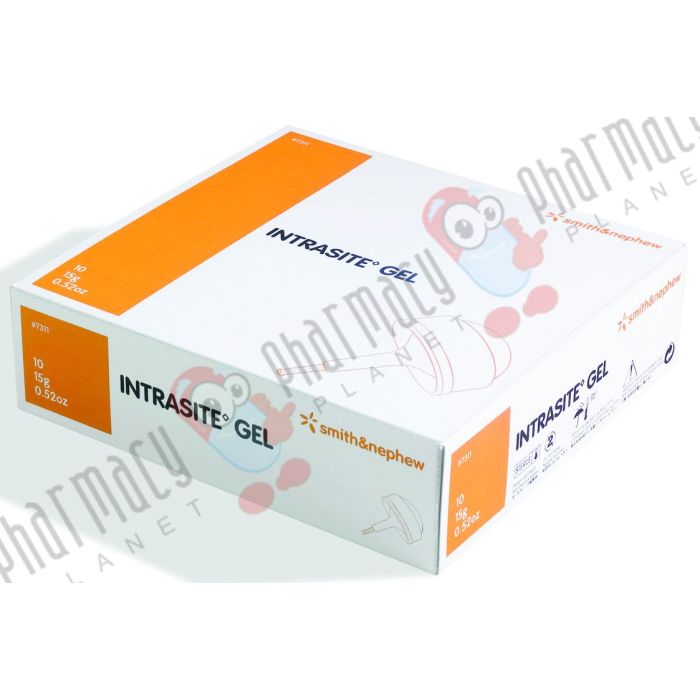
INTRASITE Gel | Sterile Hydrogel for Wound Rehydration and Autolytic Debridement
The condition of the wound bed determines how effectively healing can proceed. Dry tissue, accumulated slough, and non-viable material in the wound create a barrier to the formation of granulation tissue and re-epithelialisation. Restoring and maintaining a moist wound environment addresses this directly. INTRASITE Gel is a sterile amorphous hydrogel from Smith & Nephew that is applied directly to the wound surface. It donates moisture to the wound bed and supports the natural debridement process. Three sizes: 8g, 15g, and 25g. Secondary dressing required. No prescription needed.
What Is INTRASITE Gel?
INTRASITE Gel is an amorphous hydrogel, a clear, water-based gel formulated from propylene glycol, modified carmellose sodium, and purified water. The gel is packaged in sealed applicator tubes in three sizes. The applicator allows the gel to be placed directly and precisely onto the wound surface without the need for additional transfer instruments.
The term "amorphous" describes the physical form: INTRASITE Gel has no fixed shape. It flows to fill the wound surface when applied, conforming to irregular wound contours, shallow cavities, and wound beds that are not flat. This is distinct from INTRASITE Conformable, which is a mesh sheet carrier format that provides physical structure. INTRASITE Gel is applied as a free-flowing material directly from the tube onto or into the wound.
INTRASITE Gel is used in wound management where the wound bed contains dry tissue, slough, fibrin deposits, or necrotic material that is impeding healing. The gel addresses this by delivering water to the wound surface, raising the moisture level at the wound bed, and creating the environment in which the body's natural autolytic processes can work. The carmellose sodium component forms a gel-like structure that maintains contact with the wound surface between changes and helps retain the donated moisture at the wound bed rather than allowing it to disperse rapidly.
Three sizes are available: 8g, 15g, and 25g. Single use. Secondary dressing always required to retain the gel and protect the wound.
INTRASITE Gel donates moisture to the wound surface. It is not appropriate for wounds producing heavy exudate, adding moisture to an already wet wound risks maceration. INTRASITE Gel has no antimicrobial action. Do not use on clinically infected wounds. A secondary dressing must always be applied immediately after the gel, gel left uncovered loses moisture rapidly and loses its clinical effect. Discard any unused gel remaining in the applicator after application.
How INTRASITE Gel Works
Water Content and Wound Rehydration
INTRASITE Gel is predominantly water-based. When placed onto a wound surface that is dry or poorly hydrated, the gel releases water into the surrounding tissue through osmotic gradients between the gel and the desiccated wound. This process rehydrates dried slough, softens fibrin deposits, and restores moisture to the wound bed. Wound tissue that was too dry for cellular activity to proceed begins to recover the moist state in which healing cells can function.
Carmellose Sodium and Gel Consistency
Modified carmellose sodium is a cellulose-based polymer that gives INTRASITE Gel its viscous, gel-like consistency. This viscosity helps the gel remain at the wound surface after application rather than flowing away from the wound margins. The carmellose component also contributes to the gel's water-retaining properties, helping to keep the donated moisture at the wound bed throughout the wear period rather than dissipating quickly.
Autolytic Debridement Support
Autolytic debridement, the natural process by which the body removes non-viable tissue using its own proteolytic enzymes, is dependent on the wound being consistently moist. The enzymes responsible for breaking down slough and necrotic material are carried in wound fluid. When wound fluid is absent or inadequate because the wound is dry, enzyme activity is reduced and non-viable tissue accumulates. By raising the moisture level at the wound surface, INTRASITE Gel re-establishes the environment for autolytic activity, supporting the gradual softening and breakdown of wound debris over successive changes.
Propylene Glycol
Propylene glycol is a humectant, a substance that attracts and retains water. Its inclusion in the INTRASITE Gel formulation helps the gel retain its water content against evaporation and contributes to maintaining the moist wound environment between dressing changes. Propylene glycol is a well-established component in wound gel formulations and does not itself provide antimicrobial activity at the concentrations used in wound care products.
How to Apply INTRASITE Gel
Preparation
- Wash hands and use gloves.
- Clean the wound with sterile saline and remove any loose debris.
- Prepare the secondary dressing before opening the INTRASITE Gel applicator.
Application
- Open the applicator immediately before use.
- Apply INTRASITE Gel directly onto the wound surface.
- Cover the wound bed to a depth of approximately 3 to 5mm.
- For cavity wounds, introduce the gel into the wound space loosely - do not overfill.
- Apply the secondary dressing immediately.
- Label with the date and time of application.
Change Frequency
- Change every one to three days depending on wound condition and exudate.
- At each change, assess whether slough is softening and reducing.
- Continue use while the wound bed contains non-viable tissue that is responding to autolytic management.
- Seek clinical assessment if the wound is not improving after several changes.
Do not overfill cavity wounds. Apply loosely to coat the wound surface rather than packing the cavity densely with gel. Apply the secondary dressing immediately after the gel and ensure it seals around the wound area adequately. Discard the applicator after each use, do not reuse an opened tube.
Pack Sizes Available
INTRASITE Gel 8g
The smallest size, suited to compact wound areas and small wound surfaces where a limited amount of gel is required per application. Practical for wounds where the 8g provides adequate coverage at a single change without wastage. Single use.
INTRASITE Gel 15g
A mid-range size suited to moderate-sized wound beds, typical pressure ulcer surfaces, and wounds where 8g would not provide full wound coverage. The 15g is a commonly used size in routine wound management with INTRASITE Gel.
INTRASITE Gel 25g
The largest size, for more extensive wound areas or where the wound depth and dimensions require a greater gel volume per change. Suited to larger wound beds, extensive sloughy areas, and wounds where the smaller sizes would need multiple tubes per application. Single use; discard any unused gel remaining in the applicator.
Size selection is based on the wound dimensions and the volume of gel needed to cover the wound bed adequately at each change.
Safety Information and Precautions
Do Not Use INTRASITE Gel If
- The wound shows clinical signs of infection.
- The wound is producing moderate to heavy exudate - moisture donation risks maceration.
- Known sensitivity to propylene glycol, carmellose, or any component of the gel.
Precautions
- Always apply a secondary dressing immediately after the gel.
- Single use; discard applicator after each application.
- Do not overfill cavities.
- Reassess at each change. Seek clinical guidance if the wound is not improving.
Adverse Effects
- Wound or periwound maceration if used on wounds with exudate without appropriate secondary dressing selection.
- Skin sensitivity to propylene glycol in patients with known propylene glycol sensitivity. Discontinue and seek advice if sensitivity occurs.
Suitability
Wounds Where INTRASITE Gel Is Appropriate
- Dry, lightly exuding, sloughy, or necrotic wound beds where moisture donation and autolytic debridement are the clinical priorities
- Wounds where a free-flowing amorphous gel application is more practical than a sheet format - irregular wound surfaces, small or awkwardly located wounds, wounds requiring precise gel placement
- Cavity wounds and wound pockets where a sheet dressing cannot maintain full wound contact and a gel can be introduced into the space
- Adults and children where clinically directed
INTRASITE Gel vs INTRASITE Conformable vs GranuGEL
All three are used for dry, sloughy, and necrotic wounds through moisture donation and autolytic debridement support. INTRASITE Gel (Smith & Nephew) is a free-flowing amorphous hydrogel applied directly from an applicator tube. INTRASITE Conformable (Smith & Nephew) is a hydrogel-impregnated mesh sheet that is placed on the wound and can be cut to size. GranuGEL (ConvaTec) is an amorphous hydrocolloid gel in tube format using a different gel formulation. The choice between them is based on wound geometry, whether a sheet or amorphous format is more practical, and product availability on the prescriber's formulary or patient preference.
Purchasing INTRASITE Gel
INTRASITE Gel is a regulated medical device and does not require a prescription. All three sizes are available from Pharmacy Planet without a clinical consultation.
Our pharmacists can advise on size selection and on appropriate secondary dressings to use alongside INTRASITE Gel for specific wound types.
Wounds with significant slough or necrosis, wounds under active clinical management, or wounds not progressing as expected should be reviewed by a tissue viability nurse, district nurse, or GP alongside dressing purchase.
Storage
- Store in a cool, dry place away from direct heat and sunlight.
- Do not store above 25°C.
- Keep in original sealed packaging until immediately before use.
- Do not use if the packaging seal is broken.
- Check the expiry date before use.
- Discard any unused gel remaining in the applicator after use.
- Do not reuse an opened applicator.
- Keep out of reach of children.
Why Choose Pharmacy Planet?
Pharmacy Planet is a GPhC registered online pharmacy. All three INTRASITE Gel sizes are genuine Smith & Nephew products stocked through regulated UK supply chains.
Our pharmacists can advise on INTRASITE Gel use alongside appropriate secondary dressings and on when clinical wound assessment is the next step.
References
- Smith & Nephew. INTRASITE Gel — Instructions for Use. Smith & Nephew. https://www.smith-nephew.com. Accessed June 2026.
- National Institute for Health and Care Excellence. Wound care products: selection and prescribing. https://www.nice.org.uk. Accessed June 2026.
- Wounds UK. Best Practice Statement: Debridement in clinical practice. https://www.wounds-uk.com. Accessed June 2026.
- NHS. Pressure sores (pressure ulcers). https://www.nhs.uk/conditions/pressure-sores. Accessed June 2026.
The condition of the wound bed determines how effectively healing can proceed. Dry tissue, accumulated slough, and non-viable material in the wound create a barrier to the formation of granulation tissue and re-epithelialisation. Restoring and maintaining a moist wound environment addresses this directly. INTRASITE Gel is a sterile amorphous hydrogel from Smith & Nephew that is applied directly to the wound surface. It donates moisture to the wound bed and supports the natural debridement process. Three sizes: 8g, 15g, and 25g. Secondary dressing required. No prescription needed.
INTRASITE Gel is an amorphous hydrogel, a clear, water-based gel formulated from propylene glycol, modified carmellose sodium, and purified water. The gel is packaged in sealed applicator tubes in three sizes. The applicator allows the gel to be placed directly and precisely onto the wound surface without the need for additional transfer instruments.
The term "amorphous" describes the physical form: INTRASITE Gel has no fixed shape. It flows to fill the wound surface when applied, conforming to irregular wound contours, shallow cavities, and wound beds that are not flat. This is distinct from INTRASITE Conformable, which is a mesh sheet carrier format that provides physical structure. INTRASITE Gel is applied as a free-flowing material directly from the tube onto or into the wound.
INTRASITE Gel is used in wound management where the wound bed contains dry tissue, slough, fibrin deposits, or necrotic material that is impeding healing. The gel addresses this by delivering water to the wound surface, raising the moisture level at the wound bed, and creating the environment in which the body's natural autolytic processes can work. The carmellose sodium component forms a gel-like structure that maintains contact with the wound surface between changes and helps retain the donated moisture at the wound bed rather than allowing it to disperse rapidly.
Three sizes are available: 8g, 15g, and 25g. Single use. Secondary dressing always required to retain the gel and protect the wound.
INTRASITE Gel donates moisture to the wound surface. It is not appropriate for wounds producing heavy exudate, adding moisture to an already wet wound risks maceration. INTRASITE Gel has no antimicrobial action. Do not use on clinically infected wounds. A secondary dressing must always be applied immediately after the gel, gel left uncovered loses moisture rapidly and loses its clinical effect. Discard any unused gel remaining in the applicator after application.
Water Content and Wound Rehydration
INTRASITE Gel is predominantly water-based. When placed onto a wound surface that is dry or poorly hydrated, the gel releases water into the surrounding tissue through osmotic gradients between the gel and the desiccated wound. This process rehydrates dried slough, softens fibrin deposits, and restores moisture to the wound bed. Wound tissue that was too dry for cellular activity to proceed begins to recover the moist state in which healing cells can function.
Carmellose Sodium and Gel Consistency
Modified carmellose sodium is a cellulose-based polymer that gives INTRASITE Gel its viscous, gel-like consistency. This viscosity helps the gel remain at the wound surface after application rather than flowing away from the wound margins. The carmellose component also contributes to the gel's water-retaining properties, helping to keep the donated moisture at the wound bed throughout the wear period rather than dissipating quickly.
Autolytic Debridement Support
Autolytic debridement, the natural process by which the body removes non-viable tissue using its own proteolytic enzymes, is dependent on the wound being consistently moist. The enzymes responsible for breaking down slough and necrotic material are carried in wound fluid. When wound fluid is absent or inadequate because the wound is dry, enzyme activity is reduced and non-viable tissue accumulates. By raising the moisture level at the wound surface, INTRASITE Gel re-establishes the environment for autolytic activity, supporting the gradual softening and breakdown of wound debris over successive changes.
Propylene Glycol
Propylene glycol is a humectant, a substance that attracts and retains water. Its inclusion in the INTRASITE Gel formulation helps the gel retain its water content against evaporation and contributes to maintaining the moist wound environment between dressing changes. Propylene glycol is a well-established component in wound gel formulations and does not itself provide antimicrobial activity at the concentrations used in wound care products.
Preparation
- Wash hands and use gloves.
- Clean the wound with sterile saline and remove any loose debris.
- Prepare the secondary dressing before opening the INTRASITE Gel applicator.
Application
- Open the applicator immediately before use.
- Apply INTRASITE Gel directly onto the wound surface.
- Cover the wound bed to a depth of approximately 3 to 5mm.
- For cavity wounds, introduce the gel into the wound space loosely - do not overfill.
- Apply the secondary dressing immediately.
- Label with the date and time of application.
Change Frequency
- Change every one to three days depending on wound condition and exudate.
- At each change, assess whether slough is softening and reducing.
- Continue use while the wound bed contains non-viable tissue that is responding to autolytic management.
- Seek clinical assessment if the wound is not improving after several changes.
Do not overfill cavity wounds. Apply loosely to coat the wound surface rather than packing the cavity densely with gel. Apply the secondary dressing immediately after the gel and ensure it seals around the wound area adequately. Discard the applicator after each use, do not reuse an opened tube.
INTRASITE Gel 8g
The smallest size, suited to compact wound areas and small wound surfaces where a limited amount of gel is required per application. Practical for wounds where the 8g provides adequate coverage at a single change without wastage. Single use.
INTRASITE Gel 15g
A mid-range size suited to moderate-sized wound beds, typical pressure ulcer surfaces, and wounds where 8g would not provide full wound coverage. The 15g is a commonly used size in routine wound management with INTRASITE Gel.
INTRASITE Gel 25g
The largest size, for more extensive wound areas or where the wound depth and dimensions require a greater gel volume per change. Suited to larger wound beds, extensive sloughy areas, and wounds where the smaller sizes would need multiple tubes per application. Single use; discard any unused gel remaining in the applicator.
Size selection is based on the wound dimensions and the volume of gel needed to cover the wound bed adequately at each change.
Do Not Use INTRASITE Gel If
- The wound shows clinical signs of infection.
- The wound is producing moderate to heavy exudate - moisture donation risks maceration.
- Known sensitivity to propylene glycol, carmellose, or any component of the gel.
Precautions
- Always apply a secondary dressing immediately after the gel.
- Single use; discard applicator after each application.
- Do not overfill cavities.
- Reassess at each change. Seek clinical guidance if the wound is not improving.
Adverse Effects
- Wound or periwound maceration if used on wounds with exudate without appropriate secondary dressing selection.
- Skin sensitivity to propylene glycol in patients with known propylene glycol sensitivity. Discontinue and seek advice if sensitivity occurs.
Wounds Where INTRASITE Gel Is Appropriate
- Dry, lightly exuding, sloughy, or necrotic wound beds where moisture donation and autolytic debridement are the clinical priorities
- Wounds where a free-flowing amorphous gel application is more practical than a sheet format - irregular wound surfaces, small or awkwardly located wounds, wounds requiring precise gel placement
- Cavity wounds and wound pockets where a sheet dressing cannot maintain full wound contact and a gel can be introduced into the space
- Adults and children where clinically directed
INTRASITE Gel vs INTRASITE Conformable vs GranuGEL
All three are used for dry, sloughy, and necrotic wounds through moisture donation and autolytic debridement support. INTRASITE Gel (Smith & Nephew) is a free-flowing amorphous hydrogel applied directly from an applicator tube. INTRASITE Conformable (Smith & Nephew) is a hydrogel-impregnated mesh sheet that is placed on the wound and can be cut to size. GranuGEL (ConvaTec) is an amorphous hydrocolloid gel in tube format using a different gel formulation. The choice between them is based on wound geometry, whether a sheet or amorphous format is more practical, and product availability on the prescriber's formulary or patient preference.
INTRASITE Gel is a regulated medical device and does not require a prescription. All three sizes are available from Pharmacy Planet without a clinical consultation.
Our pharmacists can advise on size selection and on appropriate secondary dressings to use alongside INTRASITE Gel for specific wound types.
Wounds with significant slough or necrosis, wounds under active clinical management, or wounds not progressing as expected should be reviewed by a tissue viability nurse, district nurse, or GP alongside dressing purchase.
- Store in a cool, dry place away from direct heat and sunlight.
- Do not store above 25°C.
- Keep in original sealed packaging until immediately before use.
- Do not use if the packaging seal is broken.
- Check the expiry date before use.
- Discard any unused gel remaining in the applicator after use.
- Do not reuse an opened applicator.
- Keep out of reach of children.
Pharmacy Planet is a GPhC registered online pharmacy. All three INTRASITE Gel sizes are genuine Smith & Nephew products stocked through regulated UK supply chains.
Our pharmacists can advise on INTRASITE Gel use alongside appropriate secondary dressings and on when clinical wound assessment is the next step.
References
- Smith & Nephew. INTRASITE Gel — Instructions for Use. Smith & Nephew. https://www.smith-nephew.com. Accessed June 2026.
- National Institute for Health and Care Excellence. Wound care products: selection and prescribing. https://www.nice.org.uk. Accessed June 2026.
- Wounds UK. Best Practice Statement: Debridement in clinical practice. https://www.wounds-uk.com. Accessed June 2026.
- NHS. Pressure sores (pressure ulcers). https://www.nhs.uk/conditions/pressure-sores. Accessed June 2026.
INTRASITE Gel is a sterile amorphous hydrogel from Smith & Nephew for dry, sloughy, and necrotic wounds. Applied directly to the wound surface from an applicator tube, it donates moisture to the wound bed and supports autolytic debridement, the natural process by which the body removes non-viable tissue. Secondary dressing required. Three sizes: 8g, 15g, and 25g. No active pharmaceutical ingredients. No prescription required.
Both are Smith & Nephew hydrogel products for dry and sloughy wounds. INTRASITE Gel is an amorphous gel applied directly from an applicator tube, it flows to cover the wound surface. INTRASITE Conformable is a hydrogel impregnated into a conformable gauze mesh sheet, which is placed on the wound and can be cut to size. INTRASITE Gel is suited to wounds where a free-flowing application is most practical. INTRASITE Conformable is suited to wounds where a structured sheet format is preferred, particularly under compression bandaging.
Apply enough gel to cover the wound bed to a depth of approximately 3 to 5mm. This provides adequate moisture donation and gel contact with the wound surface without overfilling. For cavity wounds, introduce the gel loosely to coat the wound space rather than packing it densely. The 8g size suits small wounds, the 15g suits moderate wound surfaces, and the 25g suits larger wound beds or deeper cavities. The secondary dressing is applied immediately after the gel.
Change every one to three days depending on wound condition. At each change, assess whether the slough is softening and reducing, this is the sign that autolytic debridement is progressing. If the wound is improving, continue. If there has been no change after several applications, seek clinical guidance. The change interval may need adjustment based on wound response and exudate output. More frequent changes may be needed if exudate is washing the gel away rapidly.
The secondary dressing retains the gel against the wound surface and prevents it from drying out. For very dry wounds where maximum moisture retention is needed, a film dressing or a hydrocolloid sheet over the gel keeps moisture at the wound bed longest. For wounds with some exudate alongside dry areas, an absorbent foam or fibre secondary is more appropriate. The secondary must cover the wound fully and seal around the wound area adequately. Our pharmacists can advise on secondary dressing options for specific wound types.
No. INTRASITE Gel has no antimicrobial action and should not be used on clinically infected wounds. Signs of infection include spreading redness around the wound, fever, increasing pain, swelling, and offensive or purulent discharge. Applying a moisture-donating gel to an infected wound may worsen the clinical situation. Seek clinical assessment rather than continuing with INTRASITE Gel if infection is suspected or confirmed.
Both are amorphous gel products for dry and sloughy wounds applied directly from a tube. They are clinically similar in purpose, moisture donation and autolytic debridement support, but are different products from different manufacturers with different formulations. INTRASITE Gel (Smith & Nephew) is a hydrogel containing propylene glycol, modified carmellose sodium, and purified water. GranuGEL (ConvaTec) is a hydrocolloid gel. Both are suitable for similar wound types. Local formulary guidance or clinician preference typically informs which is used in a given clinical setting.
No. INTRASITE Gel is a regulated medical device and does not require a prescription. All three sizes, 8g, 15g, and 25g, are available from Pharmacy Planet without a clinical consultation. For wounds with significant slough or necrosis, or wounds managed under an active clinical plan, seek advice from a tissue viability nurse, district nurse, or GP alongside purchasing.

clinical consultation
Answer a few questions on your health and your fitness goals.

assessment
Our clinicians will review your clinical questionnaire to make sure treatment is right for you.

aboard!
Once approved, you will access our wealth of experience and resources curated by our team and begin your clinical journey.
Start your journey with us
Need Help?

Start your weight loss journey heading in the right direction. Our team are here to help. Whether you’re unsure about which medicine is right for you or need help navigating the world of weight loss drugs, our team are on hand to help you make the right decision. We can put you in touch with one of our experienced weight loss clinicians so you can be sure you’re making the best decision with the most accurate information.
To get in touch, contact our Customer Service team on 0800 978 8956 or email headoffice@pharmacyplanet.com.

Review By
HARMINDER ‘HARMY’ KAUR
Last Updated On : Mar 13 2026
BSc(hons) Pharmacy
GPhC Number: 2061107

Authored By
GURDEV SEHMI
Last Reviewed On : Mar 23 2026
BSc Pharm, MRPharmS, Independent Prescriber, Superintendent Pharmacist, Clinical Lead
GPhC Number: 2050925