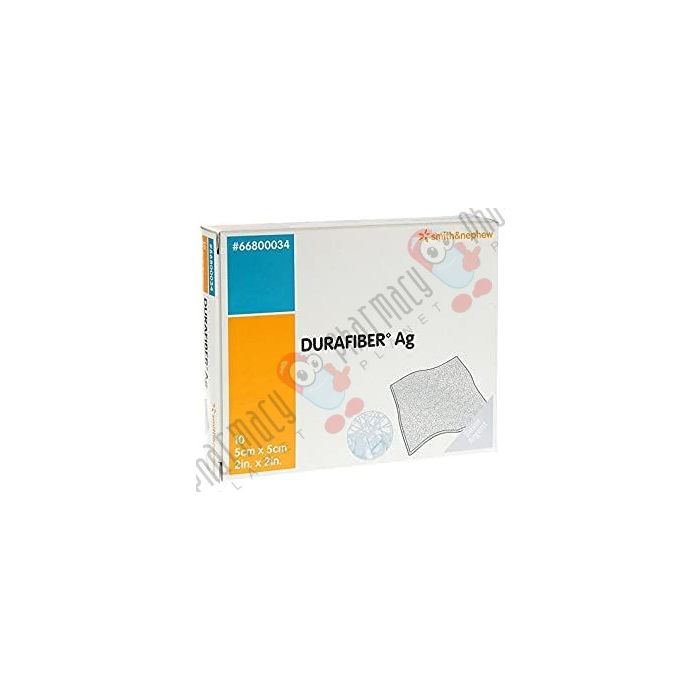
DURAFIBER Ag
Durafiber AG is an absorbent, non-woven, silver containing anticmicrobial activity against a broad spectrum of common wound pathogens which may aid in reducing bacteria and minimises risk of infection.
the items you wish
to order
by our qualified
prescriber
to your door step
Please use the options provided to make your final selection.

Select your preferred options and see the best price
| Pack | Price (£) | ||
|---|---|---|---|
| - | 5cm x 5cm [10] | 1 box | 29.99 |
| - | 4cm x 30cm [5] | 1 box | 52.99 |
| - | 20cm x 30cm [5] | 1 box | 167.99 |
| - | 2cm x 45cm [5] | 1 box | 46.49 |
| - | 4cm x 10cm [5] | 1 box | 28.49 |
| - | 4cm x 20cm [5] | 1 box | 34.49 |
| - | 10cm x 10cm [10] | 1 box | 72.49 |
| - | 15cm x 15cm [5] | 1 box | 64.49 |
It looks like you missed filling in questions from the last consultation.Click Here to submit your response.
DuraFiber Ag | Silver Gelling Fibre Dressing for Infected and At Risk Wounds
Infected and heavily colonised wounds that also produce significant exudate present a dual clinical challenge, managing the bacterial burden at the wound surface while simultaneously controlling the fluid output. DuraFiber Ag is a silver-containing gelling fibre dressing from Smith & Nephew that addresses both. The synthetic fibres gel on contact with wound exudate, absorbing it vertically and maintaining the wound surface. The ionic silver provides local antimicrobial activity. Eight configurations include flat sheets and four ribbon and strip formats for cavity wounds, sinus tracts, and deep wound management. All silver safety precautions and cavity strip safety rules apply. No prescription required.
What Is DuraFiber Ag?
DuraFiber Ag is a Class IIb regulated medical device from Smith & Nephew. It is the silver-containing version of DuraFiber, combining two properties in a single dressing: ionic silver for local antimicrobial activity, and synthetic gelling fibre for wound exudate absorption. The fibres are synthetic rather than natural alginate, giving the dressing a different absorption pattern and gel behaviour from alginate-based silver dressings.
Clinically, a gelling fibre dressing absorbs wound exudate in a predominantly vertical direction through the fibre structure, drawing fluid upward rather than allowing it to spread laterally. This vertical absorption reduces the spread of exudate onto periwound skin, which is one of the mechanisms by which these dressings help protect the skin immediately surrounding the wound.
The silver in DuraFiber Ag is ionic silver. Silver ions are released as exudate contacts the dressing and act against wound bacteria, including Staphylococcus aureus, MRSA, and Pseudomonas aeruginosa. The silver is delivered locally at the wound surface and is not a treatment for systemic infection or spreading cellulitis.
DuraFiber Ag is available in eight configurations: four flat sheet sizes and four ribbon and strip formats for cavity wounds. A secondary dressing is always required.
Silver dressings, including DuraFiber Ag, may cause grey or blue-grey discolouration of the wound and surrounding skin (argyria). This is expected, localised, and generally reversible. DuraFiber Ag is not a substitute for systemic antibiotic therapy where this is clinically indicated. Review silver dressing use after two to four weeks and step down to DuraFiber (without silver) when infection is no longer a clinical concern.
How DuraFiber Ag Works
Ionic Silver Antimicrobial Action
Ionic silver is released from the fibre structure when wound exudate contacts the dressing. Silver ions act on bacterial cells through several mechanisms: binding to and disrupting cell membrane proteins, interfering with bacterial enzyme systems needed for metabolism and replication, and preventing DNA replication. This broad-spectrum activity covers many wound pathogens encountered in infected and colonised wounds. The silver acts locally at the wound surface and does not produce the systemic effects associated with oral or intravenous antimicrobials.
Gelling Fibre Absorption
The synthetic fibres absorb wound exudate in a vertical direction through the fibre structure. As fluid is absorbed, the fibres swell and transform from a dry fibrous structure into a cohesive gel that conforms to the wound surface. This gel maintains a moist environment at the wound bed. The cohesive nature of the gel means the dressing can be lifted as a single piece at removal rather than fragmenting, which is important for retrieval from cavity wounds.
Secondary Dressing Requirement
DuraFiber Ag has no adhesive border or backing layer. It is a primary wound contact dressing only and requires a secondary dressing for fixation and additional absorbency. The secondary dressing type is chosen based on wound exudate volume and the clinical plan. For heavily exuding infected wounds, a highly absorbent secondary is needed. The DuraFiber Ag itself may need changing more frequently than the secondary if exudate levels are very high.
How to Apply DuraFiber Ag
Flat Sheet Application
- Wash hands and use gloves.
- Clean the wound with sterile saline.
- Apply DuraFiber Ag dry directly to the wound bed. Do not pre-wet.
- Apply a secondary dressing over it.
- Label with the date and time.
Ribbon and Strip Application for Cavity Wounds
- Introduce the ribbon or strip loosely into the wound cavity or sinus tract.
- Do not pack tightly.
- Always leave a visible retrieval portion outside the wound opening. Never pack the entire strip inside the wound.
- Apply a secondary dressing over the wound surface.
- Document the number of strips used.
Removal
- Irrigate the wound with sterile saline to soften the gelled fibre before removing.
- For cavity strips, retrieve by the accessible end. Count strips out and confirm full retrieval.
- If strips cannot be fully retrieved, seek urgent clinical assessment.
- Reassess at each change whether DuraFiber Ag remains appropriate.
- Review silver dressing use after two to four weeks.
For cavity strips and ribbons: count in and count out at every change. If the full strip cannot be retrieved, do not attempt further extraction. Irrigate thoroughly and seek clinical assessment before the next application. All cavity strip safety rules apply to all four strip and ribbon formats in this range: 2cm x 45cm, 4cm x 10cm, 4cm x 20cm, and 4cm x 30cm.
Configurations Available
Flat Sheets
DuraFiber Ag is available in four flat sheet sizes for wounds where surface contact is the primary application:
- 5cm x 5cm - pack of 10: Small sheet for compact wound areas.
- 10cm x 10cm - pack of 10: Medium square for moderate-sized infected or at-risk wounds.
- 15cm x 15cm - pack of 5: Larger square for more extensive wound areas.
- 20cm x 30cm - pack of 5: Large rectangular sheet for extensive wound areas, including larger pressure ulcers and leg ulcer areas requiring broad coverage.
Ribbon and Strip Formats for Cavity Wounds
Four ribbon and strip sizes are available for cavity wounds, sinus tracts, and deep wounds. All must be applied loosely with a retrieval portion outside the wound. All must be counted in and out at every change.
- 2cm x 45cm - pack of 5: Narrow ribbon for narrow cavity wounds and sinus tracts. The long length allows the full accessible cavity depth to be reached with retrieval material remaining outside.
- 4cm x 10cm - pack of 5: Short strip for shallow cavities and wound pockets where a full-length ribbon would be excessive.
- 4cm x 20cm - pack of 5: Medium strip for moderately deep cavities.
- 4cm x 30cm - pack of 5: Longer strip for deeper or larger cavity wounds where the 4cm x 20cm does not reach the full wound depth.
The choice of ribbon or strip length is guided by the cavity dimensions. The accessible wound depth and the amount of material needed outside the wound for safe retrieval both inform the selection. Seek clinical guidance from a tissue viability nurse or district nurse on cavity wound packing.
Safety Information and Precautions
Silver Safety Precautions
- Argyria: silver dressings may cause grey or blue grey discolouration of the wound and periwound skin. Expected, localised, generally reversible. Inform patients before use.
- DuraFiber Ag is not a substitute for systemic antibiotic therapy in spreading cellulitis or systemic infection.
- Review silver dressing use after two to four weeks. Step down to DuraFiber when the infection resolves.
Cavity Strip Safety Precautions
- Always leave a retrieval portion outside the wound. Never fully insert a strip inside a cavity.
- Count strips in and out at every change. Document numbers.
- Irrigate before removal to soften the gel.
- If a strip cannot be retrieved, seek clinical assessment immediately.
General Precautions
- Single use only.
- Do not use on dry wounds.
- Do not use oil-based products near the dressing.
- Do not use MRI with dressing in place.
Adverse Effects
- Argyria (silver skin discolouration) - expected and generally reversible.
- Local skin sensitivity to silver or fibre components.
Suitability
Wounds Where DuraFiber Ag Is Appropriate
- Infected or at-risk moderately to heavily exuding wounds where gelling fibre silver wound contact is clinically indicated, including venous leg ulcers, pressure ulcers, diabetic foot ulcers, and post-operative wounds
- Cavity wounds, sinus tracts, and deep wounds using the ribbon and strip formats under clinical supervision
- Adults and children under healthcare professional supervision
DuraFiber Ag vs AQUACEL Ag
Both are silver-containing gelling fibre dressings used for infected and at-risk wounds. AQUACEL Ag (ConvaTec) uses CMC hydrofibre technology. DuraFiber Ag (Smith & Nephew) uses a different synthetic fibre. Both produce a cohesive gel on exudate contact. Both require secondary dressings. Both include silver for antimicrobial activity. Both have ribbon formats for cavity wounds. Clinical selection may be guided by local formulary, clinician preference, or specific wound characteristics.
Purchasing DuraFiber Ag
DuraFiber Ag is a regulated medical device and does not require a prescription. All eight configurations are available from Pharmacy Planet.
Our pharmacists can advise on flat sheet vs ribbon selection and on whether DuraFiber Ag or a non-silver gelling fibre dressing is more appropriate for the current wound state.
Infected and cavity wounds should be managed under clinical supervision. Seek assessment from a tissue viability nurse, district nurse, or GP for complex wounds alongside dressing purchase.
Storage
- Store in a cool, dry place away from direct light.
- Do not store above 25°C.
- Keep in original sealed packaging until immediately before use.
- Do not use if packaging is damaged.
- Check expiry date before use.
- Apply as soon as packaging is opened.
- Keep out of reach of children.
- Dispose of used dressings as clinical waste.
Why Choose Pharmacy Planet?
Pharmacy Planet is a GPhC registered online pharmacy. All eight DuraFiber Ag configurations are genuine Smith & Nephew products stocked through regulated UK supply chains.
Our pharmacists can advise on silver dressing selection, ribbon and strip configuration choices for cavity wounds, and on when clinical referral for wound assessment is appropriate.
References
- Smith & Nephew. DuraFiber Ag — Instructions for Use. Smith & Nephew. https://www.smith-nephew.com. Accessed May 2026.
- World Union of Wound Healing Societies (WUWHS). Antimicrobials and non-healing wounds: evidence, controversies and suggestions. https://wuwhs.net. Accessed May 2026.
- Wounds UK. Best Practice Statement: Wound exudate — effective assessment and management. https://www.wounds-uk.com. Accessed May 2026.
- National Institute for Health and Care Excellence. Wound care products: selection and prescribing. https://www.nice.org.uk. Accessed May 2026.
Infected and heavily colonised wounds that also produce significant exudate present a dual clinical challenge, managing the bacterial burden at the wound surface while simultaneously controlling the fluid output. DuraFiber Ag is a silver-containing gelling fibre dressing from Smith & Nephew that addresses both. The synthetic fibres gel on contact with wound exudate, absorbing it vertically and maintaining the wound surface. The ionic silver provides local antimicrobial activity. Eight configurations include flat sheets and four ribbon and strip formats for cavity wounds, sinus tracts, and deep wound management. All silver safety precautions and cavity strip safety rules apply. No prescription required.
DuraFiber Ag is a Class IIb regulated medical device from Smith & Nephew. It is the silver-containing version of DuraFiber, combining two properties in a single dressing: ionic silver for local antimicrobial activity, and synthetic gelling fibre for wound exudate absorption. The fibres are synthetic rather than natural alginate, giving the dressing a different absorption pattern and gel behaviour from alginate-based silver dressings.
Clinically, a gelling fibre dressing absorbs wound exudate in a predominantly vertical direction through the fibre structure, drawing fluid upward rather than allowing it to spread laterally. This vertical absorption reduces the spread of exudate onto periwound skin, which is one of the mechanisms by which these dressings help protect the skin immediately surrounding the wound.
The silver in DuraFiber Ag is ionic silver. Silver ions are released as exudate contacts the dressing and act against wound bacteria, including Staphylococcus aureus, MRSA, and Pseudomonas aeruginosa. The silver is delivered locally at the wound surface and is not a treatment for systemic infection or spreading cellulitis.
DuraFiber Ag is available in eight configurations: four flat sheet sizes and four ribbon and strip formats for cavity wounds. A secondary dressing is always required.
Silver dressings, including DuraFiber Ag, may cause grey or blue-grey discolouration of the wound and surrounding skin (argyria). This is expected, localised, and generally reversible. DuraFiber Ag is not a substitute for systemic antibiotic therapy where this is clinically indicated. Review silver dressing use after two to four weeks and step down to DuraFiber (without silver) when infection is no longer a clinical concern.
Ionic Silver Antimicrobial Action
Ionic silver is released from the fibre structure when wound exudate contacts the dressing. Silver ions act on bacterial cells through several mechanisms: binding to and disrupting cell membrane proteins, interfering with bacterial enzyme systems needed for metabolism and replication, and preventing DNA replication. This broad-spectrum activity covers many wound pathogens encountered in infected and colonised wounds. The silver acts locally at the wound surface and does not produce the systemic effects associated with oral or intravenous antimicrobials.
Gelling Fibre Absorption
The synthetic fibres absorb wound exudate in a vertical direction through the fibre structure. As fluid is absorbed, the fibres swell and transform from a dry fibrous structure into a cohesive gel that conforms to the wound surface. This gel maintains a moist environment at the wound bed. The cohesive nature of the gel means the dressing can be lifted as a single piece at removal rather than fragmenting, which is important for retrieval from cavity wounds.
Secondary Dressing Requirement
DuraFiber Ag has no adhesive border or backing layer. It is a primary wound contact dressing only and requires a secondary dressing for fixation and additional absorbency. The secondary dressing type is chosen based on wound exudate volume and the clinical plan. For heavily exuding infected wounds, a highly absorbent secondary is needed. The DuraFiber Ag itself may need changing more frequently than the secondary if exudate levels are very high.
Flat Sheet Application
- Wash hands and use gloves.
- Clean the wound with sterile saline.
- Apply DuraFiber Ag dry directly to the wound bed. Do not pre-wet.
- Apply a secondary dressing over it.
- Label with the date and time.
Ribbon and Strip Application for Cavity Wounds
- Introduce the ribbon or strip loosely into the wound cavity or sinus tract.
- Do not pack tightly.
- Always leave a visible retrieval portion outside the wound opening. Never pack the entire strip inside the wound.
- Apply a secondary dressing over the wound surface.
- Document the number of strips used.
Removal
- Irrigate the wound with sterile saline to soften the gelled fibre before removing.
- For cavity strips, retrieve by the accessible end. Count strips out and confirm full retrieval.
- If strips cannot be fully retrieved, seek urgent clinical assessment.
- Reassess at each change whether DuraFiber Ag remains appropriate.
- Review silver dressing use after two to four weeks.
For cavity strips and ribbons: count in and count out at every change. If the full strip cannot be retrieved, do not attempt further extraction. Irrigate thoroughly and seek clinical assessment before the next application. All cavity strip safety rules apply to all four strip and ribbon formats in this range: 2cm x 45cm, 4cm x 10cm, 4cm x 20cm, and 4cm x 30cm.
Flat Sheets
DuraFiber Ag is available in four flat sheet sizes for wounds where surface contact is the primary application:
- 5cm x 5cm - pack of 10: Small sheet for compact wound areas.
- 10cm x 10cm - pack of 10: Medium square for moderate-sized infected or at-risk wounds.
- 15cm x 15cm - pack of 5: Larger square for more extensive wound areas.
- 20cm x 30cm - pack of 5: Large rectangular sheet for extensive wound areas, including larger pressure ulcers and leg ulcer areas requiring broad coverage.
Ribbon and Strip Formats for Cavity Wounds
Four ribbon and strip sizes are available for cavity wounds, sinus tracts, and deep wounds. All must be applied loosely with a retrieval portion outside the wound. All must be counted in and out at every change.
- 2cm x 45cm - pack of 5: Narrow ribbon for narrow cavity wounds and sinus tracts. The long length allows the full accessible cavity depth to be reached with retrieval material remaining outside.
- 4cm x 10cm - pack of 5: Short strip for shallow cavities and wound pockets where a full-length ribbon would be excessive.
- 4cm x 20cm - pack of 5: Medium strip for moderately deep cavities.
- 4cm x 30cm - pack of 5: Longer strip for deeper or larger cavity wounds where the 4cm x 20cm does not reach the full wound depth.
The choice of ribbon or strip length is guided by the cavity dimensions. The accessible wound depth and the amount of material needed outside the wound for safe retrieval both inform the selection. Seek clinical guidance from a tissue viability nurse or district nurse on cavity wound packing.
Silver Safety Precautions
- Argyria: silver dressings may cause grey or blue grey discolouration of the wound and periwound skin. Expected, localised, generally reversible. Inform patients before use.
- DuraFiber Ag is not a substitute for systemic antibiotic therapy in spreading cellulitis or systemic infection.
- Review silver dressing use after two to four weeks. Step down to DuraFiber when the infection resolves.
Cavity Strip Safety Precautions
- Always leave a retrieval portion outside the wound. Never fully insert a strip inside a cavity.
- Count strips in and out at every change. Document numbers.
- Irrigate before removal to soften the gel.
- If a strip cannot be retrieved, seek clinical assessment immediately.
General Precautions
- Single use only.
- Do not use on dry wounds.
- Do not use oil-based products near the dressing.
- Do not use MRI with dressing in place.
Adverse Effects
- Argyria (silver skin discolouration) - expected and generally reversible.
- Local skin sensitivity to silver or fibre components.
Wounds Where DuraFiber Ag Is Appropriate
- Infected or at-risk moderately to heavily exuding wounds where gelling fibre silver wound contact is clinically indicated, including venous leg ulcers, pressure ulcers, diabetic foot ulcers, and post-operative wounds
- Cavity wounds, sinus tracts, and deep wounds using the ribbon and strip formats under clinical supervision
- Adults and children under healthcare professional supervision
DuraFiber Ag vs AQUACEL Ag
Both are silver-containing gelling fibre dressings used for infected and at-risk wounds. AQUACEL Ag (ConvaTec) uses CMC hydrofibre technology. DuraFiber Ag (Smith & Nephew) uses a different synthetic fibre. Both produce a cohesive gel on exudate contact. Both require secondary dressings. Both include silver for antimicrobial activity. Both have ribbon formats for cavity wounds. Clinical selection may be guided by local formulary, clinician preference, or specific wound characteristics.
DuraFiber Ag is a regulated medical device and does not require a prescription. All eight configurations are available from Pharmacy Planet.
Our pharmacists can advise on flat sheet vs ribbon selection and on whether DuraFiber Ag or a non-silver gelling fibre dressing is more appropriate for the current wound state.
Infected and cavity wounds should be managed under clinical supervision. Seek assessment from a tissue viability nurse, district nurse, or GP for complex wounds alongside dressing purchase.
- Store in a cool, dry place away from direct light.
- Do not store above 25°C.
- Keep in original sealed packaging until immediately before use.
- Do not use if packaging is damaged.
- Check expiry date before use.
- Apply as soon as packaging is opened.
- Keep out of reach of children.
- Dispose of used dressings as clinical waste.
Pharmacy Planet is a GPhC registered online pharmacy. All eight DuraFiber Ag configurations are genuine Smith & Nephew products stocked through regulated UK supply chains.
Our pharmacists can advise on silver dressing selection, ribbon and strip configuration choices for cavity wounds, and on when clinical referral for wound assessment is appropriate.
References
- Smith & Nephew. DuraFiber Ag — Instructions for Use. Smith & Nephew. https://www.smith-nephew.com. Accessed May 2026.
- World Union of Wound Healing Societies (WUWHS). Antimicrobials and non-healing wounds: evidence, controversies and suggestions. https://wuwhs.net. Accessed May 2026.
- Wounds UK. Best Practice Statement: Wound exudate — effective assessment and management. https://www.wounds-uk.com. Accessed May 2026.
- National Institute for Health and Care Excellence. Wound care products: selection and prescribing. https://www.nice.org.uk. Accessed May 2026.
DuraFiber Ag is a silver gelling fibre dressing from Smith & Nephew for infected or at-risk, moderately to heavily exuding wounds. Ionic silver provides local antimicrobial activity. The synthetic gelling fibres absorb exudate vertically and gel in place. Eight configurations include flat sheets and four ribbon and strip formats for cavity wounds. A secondary dressing is always required. All silver safety precautions and cavity strip safety rules apply. No prescription required.
Both are silver gelling fibre dressings for infected wounds requiring antimicrobial wound contact. AQUACEL Ag uses ConvaTec's CMC hydrofibre technology. DuraFiber Ag uses Smith & Nephew's synthetic fibre technology. Both produce a cohesive gel on exudate contact, require secondary dressings, contain ionic silver, and include cavity formats. Clinical selection is often guided by local formulary or clinician preference. Both are used for similar wound indications. Our pharmacists can advise on availability and configuration.
The ribbon and strip formats, 2cm x 45cm, 4cm x 10cm, 4cm x 20cm, and 4cm x 30cm, are for cavity wounds, sinus tracts, and deep wounds where a flat sheet cannot reach the wound depth. They are introduced loosely into the cavity, leaving a retrieval portion outside the wound at all times. They gel in place within the cavity as they absorb exudate. A secondary dressing covers the wound surface opening. Cavity wound management should always be under clinical supervision.
Yes, provided the cavity strip safety rules are followed strictly. Introduce the strip loosely, do not pack tightly. Always leave a visible retrieval portion outside the wound opening. Count strips in and document. At removal, irrigate with saline, retrieve by the accessible end, and count out. Confirm all material has been removed before applying the next dressing. If a strip cannot be fully retrieved, seek clinical assessment immediately. Do not apply another strip until the previous one is confirmed out.
Silver dressings including DuraFiber Ag can cause grey or blue grey discolouration of the wound bed and surrounding periwound skin, a condition known as argyria. This is caused by silver deposition in the tissue. It is localised to the wound area, expected when silver dressings are used, and is generally reversible after silver use is discontinued. Patients should be informed before treatment begins. The discolouration does not indicate harm from the silver itself.
Silver dressings should be reviewed after two to four weeks of use. When the wound shows signs that infection or significant colonisation is resolving, stepping down to DuraFiber without silver is appropriate. Continuing silver dressings beyond clinical need without review is not recommended. Seek guidance from a tissue viability nurse or district nurse on the appropriate duration of silver dressing use for a specific wound. Once infection resolves, DuraFiber without Ag provides the same gelling fibre wound contact without silver.
No. DuraFiber Ag provides local silver antimicrobial activity at the wound surface and is not a treatment for spreading cellulitis, systemic infection, or sepsis. These require systemic antibiotic therapy and urgent clinical assessment. If the skin around the wound shows spreading redness, there is fever, or other systemic infection signs, seek urgent clinical advice. DuraFiber Ag can be used alongside systemic treatment for the wound surface but does not replace it.
No. DuraFiber Ag is a regulated medical device and does not require a prescription. All eight configurations are available from Pharmacy Planet. For infected or cavity wounds, clinical supervision is recommended. Seek assessment from a tissue viability nurse, district nurse, or GP for complex, infected, or non-healing wounds alongside your dressing purchase.

clinical consultation
Answer a few questions on your health and your fitness goals.

assessment
Our clinicians will review your clinical questionnaire to make sure treatment is right for you.

aboard!
Once approved, you will access our wealth of experience and resources curated by our team and begin your clinical journey.
Start your journey with us
Need Help?

Start your weight loss journey heading in the right direction. Our team are here to help. Whether you’re unsure about which medicine is right for you or need help navigating the world of weight loss drugs, our team are on hand to help you make the right decision. We can put you in touch with one of our experienced weight loss clinicians so you can be sure you’re making the best decision with the most accurate information.
To get in touch, contact our Customer Service team on 0800 978 8956 or email headoffice@pharmacyplanet.com.

Review By
HARMINDER ‘HARMY’ KAUR
Last Updated On : Mar 13 2026
BSc(hons) Pharmacy
GPhC Number: 2061107

Authored By
GURDEV SEHMI
Last Reviewed On : Mar 23 2026
BSc Pharm, MRPharmS, Independent Prescriber, Superintendent Pharmacist, Clinical Lead
GPhC Number: 2050925